Ministry of Science & Technology
Composite membranes for detecting toxic amines can prevent disasters in industries
EHSQLteam building, AMGreen and GreenkoGroupFounder Dr.Anil Chalamalasetty and Shri Mahesh Koli Sir,Shri Gautam Reddy,Dr. Rambabu P.,Shri H.Menon,Shri Ch.Srinivas Rao,Shri N.SeshaGiri, Shri S.Naidu,Shri S.S.Basha, Shri GSV Raja,Shri GVAnand,Shri K.GangadharRaoShri Satish Babu, Shri Badusha V. Shaik,Shri Sreenivas Reddy,Dr.V.S.John,Shri S. Simhachalam, Shri PVSN Raju,Shri BU.Maheswar Rao,Shri S.K.Dash, Shri R. Kadli,Shri CH A.Raju,Shri LVVRao, P.srininivaslu EHSQL by Dr.A.N.GIRI-48.2 Lakhs Viewed
Ministry of Science & Technology
Composite membranes for detecting toxic amines can prevent disasters in industries
The Government has undertaken several measures and initiatives to promote the development of renewable energy (RE), including solar and wind power, as given at Annexure that directly/indirectly incentivize industries to increase the use of RE against the consumption of energy from conventional coal-thermal based power.
The total installed capacity of solar photovoltaic (PV) power in the country is 85.47 GW and that of wind power is 46.65 GW, as on 30.06.2024.
This information was given by the Minister of State for New & Renewable Energy, Shri Shripad Yesso Naik, in a written reply in the Rajya Sabha today.
******
Annexure
The Government of India has taken several steps and initiatives to promote and accelerate renewable energy capacity in the country with the target to achieve 500 GW of installed electric capacity from non-fossil sources by 2030. These include, inter-alia, the following:
****
MJPS/SK
AM Green Ammonia reaches final investment decision on its 1 mn tonne project
AM Green is targeting 5 MTPA green ammonia capacity by 2030, aiding India's net-zero goals and contributing to Europe's green hydrogen imports.
The company's planned production equates to 1 MTPA of green hydrogen, fulfilling 20% of India's and 10% of Europe's green hydrogen targets
Greenko founders Mahesh Kolli and Anil Kumar Chalamalasetty.
AM Green Ammonia B.V., a Greenko Group venture, has reached a significant milestone with the final investment decision (FID) for its 1 million-tonne green ammonia project in Kakinada, Andhra Pradesh, the company said in a statement on Tuesday. The investment amount decided for the project is around ₹12,500 crore, a person aware of the development told Mint.
FID, a crucial step in project development, signifies the commitment of financial resources to move forward with execution.
“The FID status achieved by our Kakinada plant underscores our commitment to providing carbon-free energy solutions globally while meeting the highest standards like EU RFNBO norms,” said Anil Chalamalasetty, founder, Greenko Group & AM Green.
This also marks a pivotal moment in the company's ambitious plan to decarbonize industries worldwide and position itself as a global leader in green energy solutions, Chalamalasetty added.
With this FID, AM Green kick-starts its ambitious goal to reach a production capacity of 5 million tonnes per annum (MTPA) of green ammonia by 2030, equating to about 1 MTPA of green hydrogen.
Promoted by Greenko Group founders Mahesh Kolli and Chalamalasetty, M Green Ammonia counts Gentari and GIC among its shareholders.
The Kakinada project, with a total investment including a green hydrogen generation unit and its subsequent conversion to green ammonia, will be located at an existing urea plant that AM Green acquired earlier this year. Production is slated to commence in the second half of 2026, with the majority of output destined for European markets.
AM Green has already secured offtake agreements for the project with major players such as Uniper, Yara, Keppel, and others, targeting a range of green hydrogen applications, according to the company.
The company has locked in the necessary 1,300 MW of round-the-clock carbon-free power, enabled through a combination of 4,500 MW of solar and wind hybrid capacity and 950 MW of pumped storage project (PSP) capacity. A 25-year fixed-price power purchase agreement (PPA) with NTPC covers half of this capacity, with the remainder expected to be supplied by Gentari, the renewable energy arm of Malaysian energy giant Petronas.
In addition to its flagship Kakinada project, AM Green is eyeing multiple locations across India to achieve its 5 MTPA green ammonia target by 2030. This expansion is expected to significantly boost efforts toward achieving net-zero targets both in India and OECD market.
The planned capacity will equate to approximately 1 MTPA of green hydrogen, representing one-fifth of India’s green hydrogen production target under the National Green Hydrogen Mission and 10% of Europe’s import target for green hydrogen by 2030.
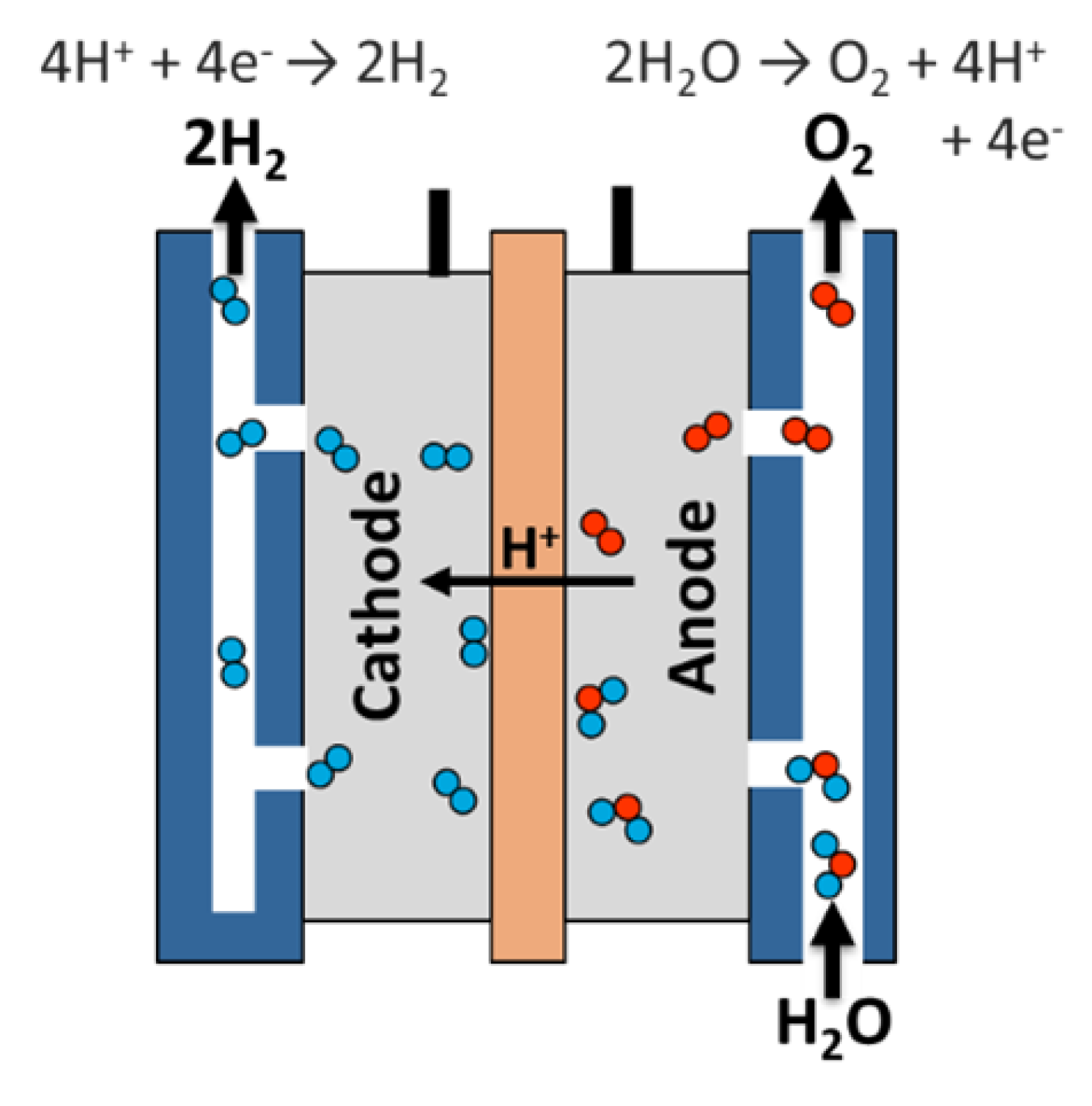
Electrolysis is a promising option for carbon-free hydrogen production from renewable and nuclear resources. Electrolysis is the process of using electricity to split water into hydrogen and oxygen. This reaction takes place in a unit called an electrolyzer. Electrolyzers can range in size from small, appliance-size equipment that is well-suited for small-scale distributed hydrogen production to large-scale, central production facilities that could be tied directly to renewable or other non-greenhouse-gas-emitting forms of electricity production.

Like fuel cells, electrolyzers consist of an anode and a cathode separated by an electrolyte. Different electrolyzers function in different ways, mainly due to the different type of electrolyte material involved and the ionic species it conducts.
In a polymer electrolyte membrane (PEM) electrolyzer, the electrolyte is a solid specialty plastic material.
Alkaline electrolyzers operate via transport of hydroxide ions (OH-) through the electrolyte from the cathode to the anode with hydrogen being generated on the cathode side. Electrolyzers using a liquid alkaline solution of sodium or potassium hydroxide as the electrolyte have been commercially available for many years. Newer approaches using solid alkaline exchange membranes (AEM) as the electrolyte are showing promise on the lab scale.
Solid oxide electrolyzers, which use a solid ceramic material as the electrolyte that selectively conducts negatively charged oxygen ions (O2-) at elevated temperatures, generate hydrogen in a slightly different way.
Solid oxide electrolyzers must operate at temperatures high enough for the solid oxide membranes to function properly (about 700°–800°C, compared to PEM electrolyzers, which operate at 70°–90°C, and commercial alkaline electrolyzers, which typically operate at less than 100°C). Advanced lab-scale solid oxide electrolyzers based on proton-conducting ceramic electrolytes are showing promise for lowering the operating temperature to 500°–600°C. The solid oxide electrolyzers can effectively use heat available at these elevated temperatures (from various sources, including nuclear energy) to decrease the amount of electrical energy needed to produce hydrogen from water.
Electrolysis is a leading hydrogen production pathway to achieve the Hydrogen Energy Earthshot goal of reducing the cost of clean hydrogen by 80% to $1 per 1 kilogram in 1 decade ("1 1 1"). Hydrogen produced via electrolysis can result in zero greenhouse gas emissions, depending on the source of the electricity used. The source of the required electricity—including its cost and efficiency, as well as emissions resulting from electricity generation—must be considered when evaluating the benefits and economic viability of hydrogen production via electrolysis. In many regions of the country, today's power grid is not ideal for providing the electricity required for electrolysis because of the greenhouse gases released and the amount of fuel required due to the low efficiency of the electricity generation process. Hydrogen production via electrolysis is being pursued for renewable (wind, solar, hydro, geothermal) and nuclear energy options. These hydrogen production pathways result in virtually zero greenhouse gas and criteria pollutant emissions; however, the production cost needs to be decreased significantly to be competitive with more mature carbon-based pathways such as natural gas reforming.
Potential for synergy with renewable energy power generation
Hydrogen production via electrolysis may offer opportunities for synergy with dynamic and intermittent power generation, which is characteristic of some renewable energy technologies. For example, though the cost of wind power has continued to drop, the inherent variability of wind is an impediment to the effective use of wind power. Hydrogen fuel and electric power generation could be integrated at a wind farm, allowing flexibility to shift production to best match resource availability with system operational needs and market factors. Also, in times of excess electricity production from wind farms, instead of curtailing the electricity as is commonly done, it is possible to use this excess electricity to produce hydrogen through electrolysis.
It is important to note...