What is Acid Rain?
Acid rain, or acid deposition, is a broad term that includes any
form of precipitation with acidic components, such as sulfuric or nitric
acid that fall to the ground from the atmosphere in wet or dry forms.
This can include rain, snow, fog, hail or even dust that is acidic.
What Causes Acid Rain?
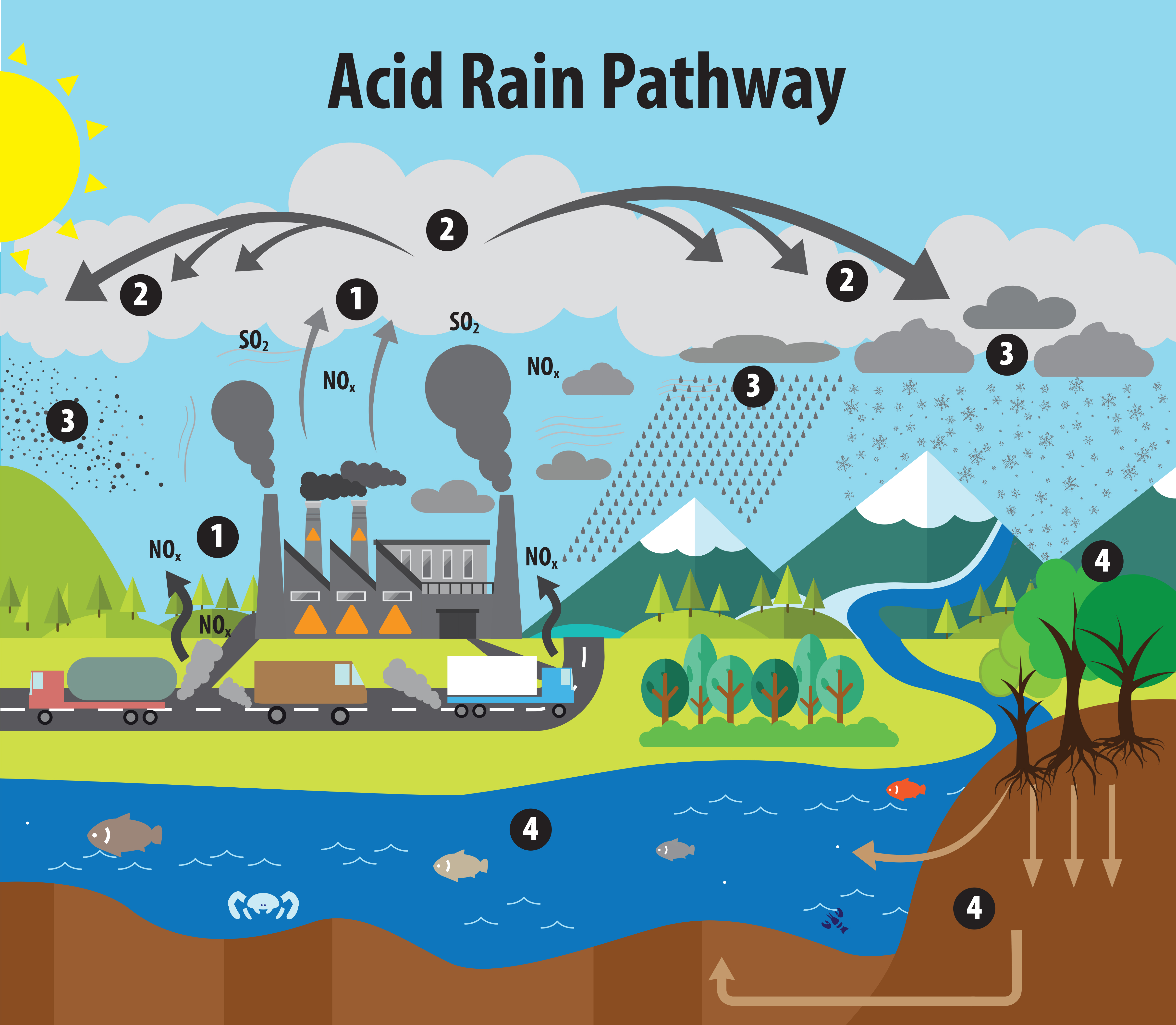 This image illustrates the pathway for acid rain in our environment: (1) Emissions of SO2 and NOx are
released into the air, where (2) the pollutants are transformed into
acid particles that may be transported long distances. (3) These acid
particles then fall to the earth as wet and dry deposition (dust, rain,
snow, etc.) and (4) may cause harmful effects on soil, forests, streams,
and lakes.
This image illustrates the pathway for acid rain in our environment: (1) Emissions of SO2 and NOx are
released into the air, where (2) the pollutants are transformed into
acid particles that may be transported long distances. (3) These acid
particles then fall to the earth as wet and dry deposition (dust, rain,
snow, etc.) and (4) may cause harmful effects on soil, forests, streams,
and lakes.
Acid rain results when sulfur dioxide (SO2) and nitrogen oxides (NOX) are emitted into the atmosphere and transported by wind and air currents. The SO2 and NOX
react with water, oxygen and other chemicals to form sulfuric and
nitric acids. These then mix with water and other materials before
falling to the ground.
While a small portion of the SO2 and NOX that
cause acid rain is from natural sources such as volcanoes, most of it
comes from the burning of fossil fuels. The major sources of SO2 and NOX in the atmosphere are:
- Burning of fossil fuels to generate electricity. Two thirds of SO2 and one fourth of NOX in the atmosphere come from electric power generators.
- Vehicles and heavy equipment.
- Manufacturing, oil refineries and other industries.
Winds can blow SO2 and NOX over long
distances and across borders making acid rain a problem for everyone and
not just those who live close to these sources.
Forms of Acid Deposition
Wet Deposition
Wet deposition is what we most commonly think of as acid rain. The sulfuric and nitric acids formed in the atmosphere fall to the ground mixed with rain, snow, fog, or hail.
Dry Deposition
Acidic particles and gases can also deposit from the atmosphere in the absence of moisture as dry deposition.
The acidic particles and gases may deposit to surfaces (water bodies,
vegetation, buildings) quickly or may react during atmospheric transport
to form larger particles that can be harmful to human health. When the
accumulated acids are washed off a surface by the next rain, this acidic
water flows over and through the ground, and can harm plants and
wildlife, such as insects and fish.
The amount of acidity in the atmosphere that deposits to earth
through dry deposition depends on the amount of rainfall an area
receives. For example, in desert areas the ratio of dry to wet
deposition is higher than an area that receives several inches of rain
each year.
Top of Page
Measuring Acid Rain
 Acidity
and alkalinity are measured using a pH scale for which 7.0 is neutral.
The lower a substance's pH (less than 7), the more acidic it is; the
higher a substance's pH (greater than 7), the more alkaline it is.
Normal rain has a pH of about 5.6; it is slightly acidic because carbon
dioxide (CO2) dissolves into it forming weak carbonic acid. Acid rain usually has a pH between 4.2 and 4.4.
Acidity
and alkalinity are measured using a pH scale for which 7.0 is neutral.
The lower a substance's pH (less than 7), the more acidic it is; the
higher a substance's pH (greater than 7), the more alkaline it is.
Normal rain has a pH of about 5.6; it is slightly acidic because carbon
dioxide (CO2) dissolves into it forming weak carbonic acid. Acid rain usually has a pH between 4.2 and 4.4.
Policymakers, research scientists, ecologists, and modelers rely on
the National Atmospheric Deposition Program’s (NADP) National Trends
Network (NTN) for measurements of wet deposition. The NADP/NTN collects
acid rain at more than 250 monitoring sites throughout the US, Canada,
Alaska, Hawaii and the US Virgin Islands. Unlike wet deposition, dry
deposition is difficult and expensive to measure. Dry deposition
estimates for nitrogen and sulfur pollutants are provided by the Clean
Air Status and Trends Network (CASTNET). Air concentrations are measured
by CASTNET at more than 90 locations.
When acid deposition is washed into lakes and streams, it can cause
some to turn acidic. The Long-Term Monitoring (LTM) Network measures and
monitors surface water chemistry at over 280 sites to provide valuable
information on aquatic ecosystem health and how water bodies respond to
changes in acid-causing emissions and acid deposition.


