Saturday, 6 March 2021

The Effects of Acid Rain on Ecosystems


The Effects of Acid Rain on Ecosystems

Graph showing level of acidity that is tolerable to various species of aquatic lifeThis figure illustrates the pH level at which key organisms may be lost as their environment becomes more acidic. Not all fish, shellfish, or the insects that they eat can tolerate the same amount of acid.

An ecosystem is a community of plants, animals and other organisms along with their environment including the air, water and soil. Everything in an ecosystem is connected. If something harms one part of an ecosystem – one species of plant or animal, the soil or the water – it can have an impact on everything else.

Effects of Acid Rain on Fish and Wildlife

The ecological effects of acid rain are most clearly seen in aquatic environments, such as streams, lakes, and marshes where it can be harmful to fish and other wildlife. As it flows through the soil, acidic rain water can leach aluminum from soil clay particles and then flow into streams and lakes. The more acid that is introduced to the ecosystem, the more aluminum is released.

Some types of plants and animals are able to tolerate acidic waters and moderate amounts of aluminum. Others, however, are acid-sensitive and will be lost as the pH declines. Generally, the young of most species are more sensitive to environmental conditions than adults. At pH 5, most fish eggs cannot hatch. At lower pH levels, some adult fish die. Some acidic lakes have no fish. Even if a species of fish or animal can tolerate moderately acidic water, the animals or plants it eats might not. For example, frogs have a critical pH around 4, but the mayflies they eat are more sensitive and may not survive pH below 5.5.

Effects of Acid Rain on Plants and Trees

Dead or dying trees are a common sight in areas effected by acid rain. Acid rain leaches aluminum from the soil.  That aluminum may be harmful to plants as well as animals. Acid rain also removes minerals and nutrients from the soil that trees need to grow. 

At high elevations, acidic fog and clouds might strip nutrients from trees’ foliage, leaving them with brown or dead leaves and needles. The trees are then less able to absorb sunlight, which makes them weak and less able to withstand freezing temperatures.

Buffering Capacity

Many forests, streams, and lakes that experience acid rain don’t suffer effects because the soil in those areas can buffer the acid rain by neutralizing the acidity in the rainwater flowing through it. This capacity depends on the thickness and composition of the soil and the type of bedrock underneath it. In areas such as mountainous parts of the Northeast United States, the soil is thin and lacks the ability to adequately neutralize the acid in the rain water. As a result, these areas are particularly vulnerable and the acid and aluminum can accumulate in the soil, streams, or lakes.

Episodic Acidification

Melting snow and heavy rain downpours can result in what is known as episodic acidification. Lakes that do not normally have a high level of acidity may temporarily experience effects of acid rain when the melting snow or downpour brings greater amounts of acidic deposition and the soil can’t buffer it. This short duration of higher acidity (i.e., lower pH) can result in a short-term stress on the ecosystem where a variety of organisms or species may be injured or killed.

Nitrogen Pollution

It’s not just the acidity of acid rain that can cause problems. Acid rain also contains nitrogen, and this can have an impact on some ecosystems. For example, nitrogen pollution in our coastal waters is partially responsible for declining fish and shellfish populations in some areas. In addition to agriculture and wastewater, much of the nitrogen produced by human activity that reaches coastal waters comes from the atmosphere.


Effects of Acid Rain on Materials

Not all acidic deposition is wet. Sometimes dust particles can become acidic as well, and this is called dry deposition. When acid rain and dry acidic particles fall to earth, the nitric and sulfuric acid that make the particles acidic can land on statues, buildings, and other manmade structures, and damage their surfaces. The acidic particles corrode metal and cause paint and stone to deteriorate more quickly. They also dirty the surfaces of buildings and other structures such as monuments.

The consequences of this damage can be costly:

  • damaged materials that need to be repaired or replaced,
  • increased maintenance costs, and
  • loss of detail on stone and metal statues, monuments and tombstones.


What Causes Acid Rain?


What is Acid Rain?

Acid rain, or acid deposition, is a broad term that includes any form of precipitation with acidic components, such as sulfuric or nitric acid that fall to the ground from the atmosphere in wet or dry forms.  This can include rain, snow, fog, hail or even dust that is acidic.  

What Causes Acid Rain?

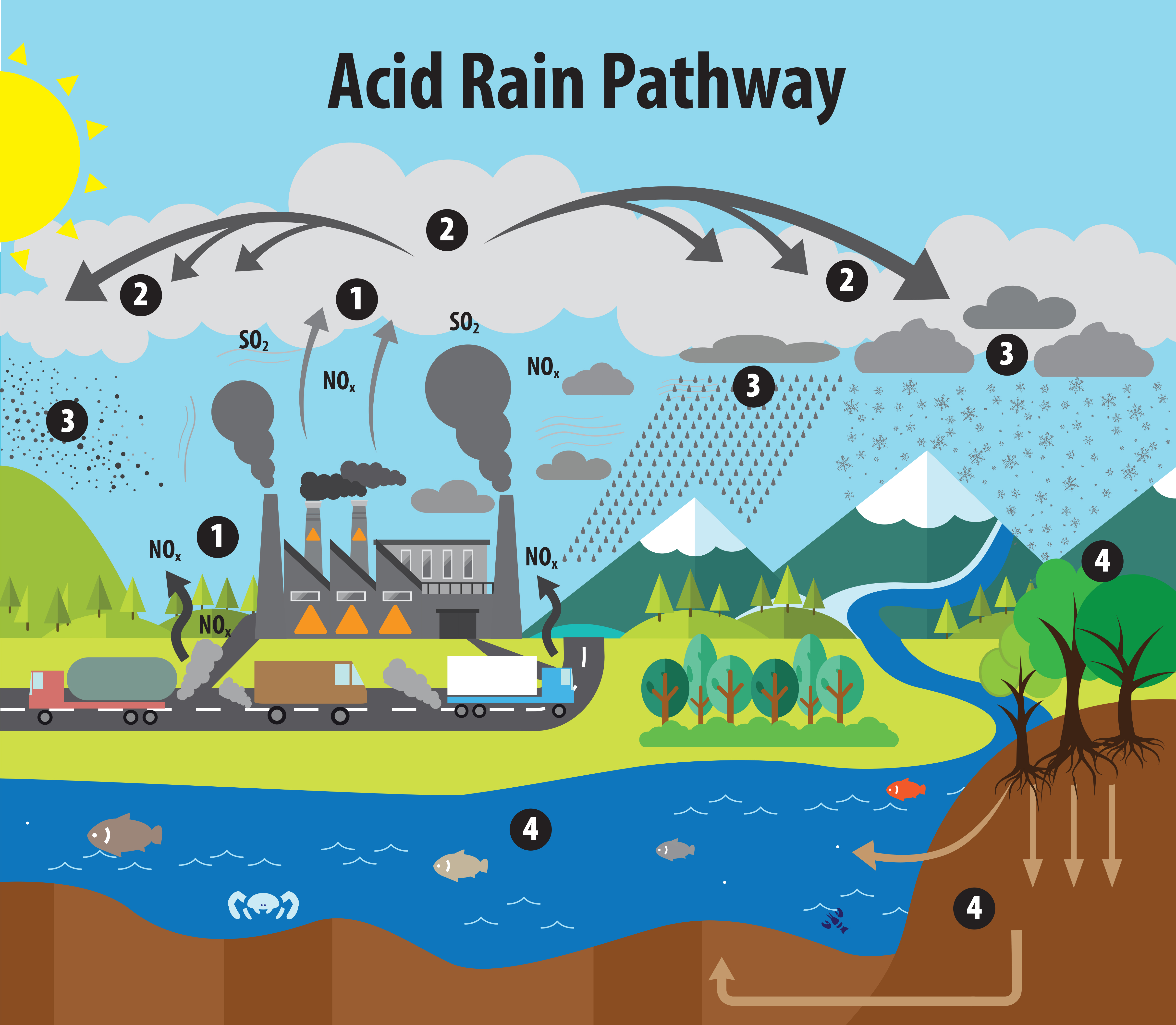
This image illustrates the pathway for acid rain in our environment.This image illustrates the pathway for acid rain in our environment: (1) Emissions of SO2 and NOx are released into the air, where (2) the pollutants are transformed into acid particles that may be transported long distances. (3) These acid particles then fall to the earth as wet and dry deposition (dust, rain, snow, etc.) and (4) may cause harmful effects on soil, forests, streams, and lakes.

Acid rain results when sulfur dioxide (SO2) and nitrogen oxides (NOX) are emitted into the atmosphere and transported by wind and air currents. The SO2 and NOX react with water, oxygen and other chemicals to form sulfuric and nitric acids.  These then mix with water and other materials before falling to the ground.

While a small portion of the SO2 and NOX that cause acid rain is from natural sources such as volcanoes, most of it comes from the burning of fossil fuels.  The major sources of SO2 and NOX in the atmosphere are:

  • Burning of fossil fuels to generate electricity.  Two thirds of SO2 and one fourth of NOX in the atmosphere come from electric power generators.
  • Vehicles and heavy equipment.
  • Manufacturing, oil refineries and other industries.

Winds can blow SO2 and NOX over long distances and across borders making acid rain a problem for everyone and not just those who live close to these sources. 


Forms of Acid Deposition

Wet Deposition

Wet deposition is what we most commonly think of as acid rain.  The sulfuric and nitric acids formed in the atmosphere fall to the ground mixed with rain, snow, fog, or hail.  

Dry Deposition

Acidic particles and gases can also deposit from the atmosphere in the absence of moisture as dry deposition.  The acidic particles and gases may deposit to surfaces (water bodies, vegetation, buildings) quickly or may react during atmospheric transport to form larger particles that can be harmful to human health. When the accumulated acids are washed off a surface by the next rain, this acidic water flows over and through the ground, and can harm plants and wildlife, such as insects and fish.

The amount of acidity in the atmosphere that deposits to earth through dry deposition depends on the amount of rainfall an area receives.  For example, in desert areas the ratio of dry to wet deposition is higher than an area that receives several inches of rain each year.

Top of Page


Measuring Acid Rain

A diagram showing where various substances fall on the pH scale.Acidity and alkalinity are measured using a pH scale for which 7.0 is neutral. The lower a substance's pH (less than 7), the more acidic it is; the higher a substance's pH (greater than 7), the more alkaline it is. Normal rain has a pH of about 5.6; it is slightly acidic because carbon dioxide (CO2) dissolves into it forming weak carbonic acid.  Acid rain usually has a pH between 4.2 and 4.4.

Policymakers, research scientists, ecologists, and modelers rely on the National Atmospheric Deposition Program’s (NADP) National Trends Network (NTN) for measurements of wet deposition. The NADP/NTN collects acid rain at more than 250 monitoring sites throughout the US, Canada, Alaska, Hawaii and the US Virgin Islands. Unlike wet deposition, dry deposition is difficult and expensive to measure. Dry deposition estimates for nitrogen and sulfur pollutants are provided by the Clean Air Status and Trends Network (CASTNET). Air concentrations are measured by CASTNET at more than 90 locations.

When acid deposition is washed into lakes and streams, it can cause some to turn acidic. The Long-Term Monitoring (LTM) Network measures and monitors surface water chemistry at over 280 sites to provide valuable information on aquatic ecosystem health and how water bodies respond to changes in acid-causing emissions and acid deposition.

Thursday, 25 February 2021

Occupational Exposure Guidelines--Emergency response guidelines

 Emergency response guidelines are often needed during a spill incident, in order to help determine the level of concern (LOC) in case of a possible population exposure. The LOC selected may greatly affect the response activity. Choosing a LOC that is unnecessarily low may result in unneeded evacuation. An evacuation of a population center is a risky operation that may have serious consequences (consider evacuating hospitals, with patients on life support systems). On the other hand, selecting a LOC that is too high may lead to harmful exposure to the population.

Over the years, several sets of exposure guidelines have been developed for both the work force and the general public. Since these two groups differ in many aspects, exposure guidelines that serve one group may not be applicable to the other. 


Occupational Exposure Guidelines

Legal standards for workplace exposures are established by the Occupational Safety and Health Administration (OSHA). These standards are known as Permissible Exposure Limits (PELs). These limits are a legal requirement for occupational exposures, and exceeding them is a violation of the law, for which fines may be imposed. Most OSHA PELs are for airborne substances with allowable exposure limits averaged over an 8-hr day, 40-hr week. This is known as the Time-Weighted-Average (TWA) PEL. Adverse effects should not be encountered with repeated exposures at the TWA PEL.

OSHA also issues Short Term Exposure Limit (STELs) PELs, Ceiling Limit PELs, and PELs that carry a skin designation. PEL STELs are concentration limits of substances in the air that a worker may be exposed to for 15 minutes without suffering adverse effects. The 15 minute STEL is usually considerably higher than the 8-hour TWA exposure level. For example, for trichloroethylene the PEL-STEL is 200 ppm whereas the PEL-TWA is 50 ppm.

Ceiling Limit PELs are concentration limits for airborne substances that should never be exceeded. A skin designation indicates that the substance can be readily absorbed through the skin, eye or mucous membranes, and substantially contribute to the dose that a worker receives from inhalation of the substance.

Theoretically, an occupational substance could have PELs as TWA, STEL, and Ceiling Limit, and with a skin designation. This is rare however. Usually, a OSHA regulated substance will have only a PEL as a time-weighted average. About 20% of the OSHA regulated substances have PEL-STELs and only about 10% have skin notations. In a few cases, a substance may have a PEL-Ceiling but not a PEL-TWA.

An occupational exposure guideline developed by the OSHA Standards Completion Program is the Immediately Dangerous to Life and Health (IDLH). The IDLH is a condition "that poses a threat of exposure to airborne contaminants when that exposure is likely to cause death or immediate or delayed permanent adverse health effects or prevent escape from such an environment." For concentrations above the IDLH, a self-contained breathing apparatus (SCBA) is required. Below that level, air-purifying respirators may be used, if appropriate. Unlike previous definition of the IDLH, which incorporated a 30-minute time period, the new definition (1994) does not have an exposure duration associated with it. If you are in an IDLH condition, you need to get out of there immediately! Using IDLH as a LOC may not be appropriate when the general public is the population at risk because IDLHs were developed for the typical worker (a healthy adult) and allow for some discomfort or even temporary health effect at the level suggested.

When OSHA was formed in 1971, it immediately adopted existing occupational heath guidelines for its PELs. These guidelines were those of the American National Standards Institute (ANSI), American Conference of Governmental Industrial Hygienists (ACGIH), and National Institute for Occupational Safety and Health (NIOSH). OSHA also developed health standards for over 30 other workplace hazards based on risk assessments that they conducted.

The guidelines issued by the ACGIH are known as Threshold Limit Values (TLVs). NIOSH guidelines are designated as NIOSH Recommended Exposure Limits (RELs). Three types of TLVs exist as previously described for OSHA PELs. They are: Threshold Limit Value Time-Weighted Average (TLV-TWA), TLV as a Short-Term Exposure Limit (TLV-STELs), and Threshold Limit Value as a Ceiling Limit (TLV-C). The NIOSH RELs are also designated as time-weighted average, short-term exposure limits and ceiling limits.

TLV-TWA

Time-Weighted Average (TWA) exposure to a substance is the level to which workers may be exposed for an 8-hour work shift without suffering an adverse effect.

TLV-TWA is meant to regulate exposure over an 8-hour period. Don't extrapolate to shorter periods of time. Don't assume that if a certain limit applies for 8 hours, then eight times that limit may be applied if the exposure lasts for only 1 hour. It simply doesn't work that way. Therefore, the 8-hour limits may not be very useful for spill response, where exposure durations are usually much shorter than 8 hours.

TLV-STEL

The STEL is a 15-minute exposure limit that should not be exceeded even if the 8-hour TLV remains within the limit. Such limits were assigned to substances exerting toxic effects even over a short period of time. Where a STEL limit is not available (but is believed to be justified), it is recommended that a limit three times as high as the TLV for a 15-minute exposure be used.

Ceiling

A TLV with a ceiling notation ("C") represents an "excursion limit" that may not be exceeded at any time. Ceiling values are used for substances known to be fast-acting such as irritating gases. While the TLV-TWA allows excursions above the limit as long as they are compensated for by periods of low exposure, ceiling limits do not allow such excursions.

REL

The Recommended Exposure Limits (RELs) were developed by the National Institute of Occupational Safety and Health (NIOSH). Those standards are similar to TLVs in the way that they were derived, but are often stricter. The RELs are published in the NIOSH Pocket Guide To Chemical Hazards, which is updated every few years, and in other NIOSH publications.


NIOSH - National Institute for Occupational Safety and Health

The "immediately dangerous to life or health air concentration values (IDLHs)" used by the National Institute for Occupational Safety and Health (NIOSH) as respirator selection criteria were first developed in the mid-1970's. The Documentation for Immediately Dangerous to Life or Health Concentrations (IDLHs) is a compilation of the rationale and sources of information used by NIOSH during the original determination of 387 IDLHs and their subsequent review and revision in 1994.

NPG - NIOSH Pocket Guide to Chemical Hazards

The NPG is intended as a source of general industrial hygiene information on several hundred chemicals/classes for workers, employers, and occupational health professionals. The NPG does not contain an analysis of all pertinent data, rather it presents key information and data in abbreviated or tabular form for chemicals or substance groupings (e.g. cyanides, fluorides, manganese compounds) that are found in the work environment. The information found in the NPG should help users recognize and control occupational chemical hazards.

Public Exposure Guidelines

Public exposure guidelines are meant to protect all segments of the population, including the very young and very old, pregnant women, and hypersensitive individuals. However, relatively few public exposure guidelines have been developed, so spill responders commonly use occupational standards and their own best judgment to select a LOC.

ERPG

The Emergency Response Planning Guidelines (ERPG) were developed under the guidance of a committee within the American Industrial Hygiene Association (AIHA). It is a three-tier standard with one common denominator, a 1-hour contact duration. Each standard identifies the substance, its chemical and structural properties, animal toxicology data, human experience, existing exposure guidelines, the rationale behind the selected value, and a list of references.

The ERPG does not contain safety factors usually incorporated into exposure standards such as the TLV. At the ERPG-1, for example, most people would detect the chemical and may have temporary mild effects. At ERPG-3, on the other hand, it is estimated that the effects would be severe, although not life threatening. The TLV, on the other hand, incorporate a safety factor into its standards, to prevent any ill effects. The ERPG should serve as a planning tool, not a standard to protect the public.

ERPG standards have been defined for only 35 substances.

EEGL

Emergency Exposure Guidance Levels (EEGLs) were developed by the National Research Council Committee on Toxicology for the Department of Defense for planning operations under emergency conditions such as spills, fires, and other contamination. Exposure duration was set at 1 to 24 hours. The exposures allowed are not safe but tolerable, and temporary effects are tolerated. The EEGLs were developed for young, healthy military personnel, so the same logic that applies to the IDLH applies to EEGLs: exposure that may be a nuisance to a young and healthy adult may be a real problem for a compromised individual. EEGL standards were developed for 41 substances, some of them used almost exclusively by the military.

SPGEL

The Short-term Public Exposure Guidance Levels (SPEGL) were developed as public exposure guidelines for civilian populations. Effects were considered for all groups of the public. Only five SPEGLs have been developed: hydrazine, dimethylhydrazine, monomethyl hydrazine, nitrogen dioxide, and hydrogen chloride.

Periodic Table of Elements