Union Jal Shakti Minister Shri C.R. Patil hosted water conservation warriors from across India at his residence
Grassroots activists shared inspiring stories of river conservation, water conservation and community mobilization
Shri Patil called for targeted action, measurable results and widespread public participation
Smt. Archana Verma, Secretary, Department of Water Resources, River Development and Ganga Rejuvenation, appreciated the role played in mobilizing communities on collective action on water issues
Union Minister for Jal Shakti, Shri C.R. Patil, today interacted with Jal Sanrakshan Yoddhas and Nadi Sanrakshan Yoddhas from various parts of the country who are leading grassroots initiatives in the areas of water conservation, river and waterbody protection, and environmental conservation. Organized by the National Mission for Clean Ganga (NMCG) under the Namami Ganga Abhiyan, the interaction provided a platform for these grassroots warriors to share their experiences, learn from each other, and discuss ways to strengthen successful community-led models and implement them across the country.
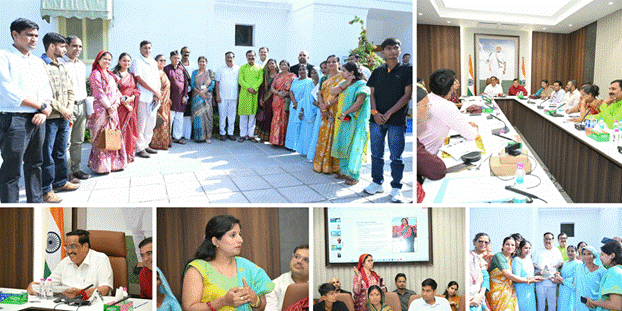
Participants shared their firsthand experiences restoring rivers and ponds, volunteering, promoting rainwater harvesting, removing plastic and other waste from near water bodies, leading tree-planting drives, and mobilizing women, youth, volunteers, and local communities. Their stories highlighted how individual initiative, combined with collective action and community participation, can lead to visible and lasting improvements at the grassroots level.
Among those who shared their work was Ramveer Tanwar, also known as "India's Pond Lover." He spoke about reviving over 100 ponds and establishing 10 small urban forests. Kamini Kumari from Bihar highlighted her initiative to organize 500 women to build 500 self-filling water pits in a single day along the Baya River, linking water conservation with groundwater recharge, sustainable agriculture, and livelihood opportunities for women.
Surendra Singh Chaudhary, popularly known as "Bittu Tabahi," shared his journey of cleaning the polluted Ajnar River in Biaora, Rajgarh district, Madhya Pradesh. The young BSc student began this effort on January 26, 2026, and on his own initiative, removed plastic, weeds, sludge, and other debris from the river. What began as a local effort has garnered widespread public attention and inspired greater participation in the cleaning and restoration of local water bodies.
Anand Malligad from Bengaluru spoke about his work reviving 33 lakes and planting over one lakh native trees. Jagdish Singh Negi from Uttarakhand shared his work in water conservation, forest restoration, and converting plastic waste into eco-friendly bricks. Shubham Kumar highlighted the role of youth and volunteers in river cleanup and his efforts to mobilize communities to remove over 2.47 lakh kilograms of garbage from the banks of the Ganga and its tributaries.
The dialogue also highlighted the role of water volunteers and community groups in maintaining clean rivers and ghats. Akash Yadav from Uttar Pradesh shared how his 15-member volunteer group contributed to the restoration of four ghats on the Ganga and the removal of over a ton of plastic waste. Dr. Sanjivani Sharma from Kanpur spoke about mobilizing over 900 volunteers for the Ganga Conservation Campaign and removing over 120 metric tons of waste, as well as promoting livelihood opportunities for women through plastic recycling, reuse of waste materials, and community-led waste management.
Other water warriors included Ms. Kusum Gildiyal, Mr. Jagdish Negi, Ms. Rama Tiwari, Dr. Suman Pandey, Ms. Kumari Sunita Singh, Mr. Sanjay Kumar Singh, Mr. Ajay Kumar Tiwari, Mr. Nitish Kumar Singh, Mr. Kamlesh Bhai Shastri, Mr. Sandeep Chaudhary, Ms. Sirkunwar, Ms. Phoolbati, and Mr. Vivek Bhat. The work of these warriors was highly appreciated by the Honorable Minister of Jal Shakti.
Addressing the gathering, Smt. Archana Verma, Secretary, Department of Water Resources, River Development and Ganga Rejuvenation, commended the role of Jal Warriors in taking the message of water conservation and sanitation to communities beyond government programs. She praised their ability to mobilize people near rivers, ponds, and other water bodies and organize collective action, emphasizing that such citizen-led participation is essential for sustaining water conservation and river protection efforts in the long term.
Addressing the participants, Mr. C.R. Patil congratulated them for their commitment and said that hearing their experiences firsthand was an opportunity to understand the scale, diversity, and impact of grassroots work underway across the country. He acknowledged that many of them worked in difficult local conditions and yet succeeded in mobilizing people for water and environmental conservation. Referring to the broader national movement, Mr. Patil said that under the visionary leadership of the Honorable Prime Minister, Mr. Narendra Modi, water conservation has transformed into a nationwide mass movement based on public participation. He said that the Prime Minister's constant emphasis on conserving every drop of water has inspired citizens and communities across the country to take responsibility for water conservation, and the work of the Water Warriors reflects this spirit of collective action.
The Minister emphasized that the next step should be to channel this energy into targeted, measurable, and sustained results. He encouraged participants to identify specific rivers, ponds, ghats, and other water bodies, set clear goals, and demonstrate visible improvements on the ground. He also stressed the importance of involving women, youth, schoolchildren, senior citizens, and other sections of society, so that water conservation and sanitation become a sustainable mass movement rather than one-time activities.
Mr. Patil encouraged water warriors to stay connected, regularly share their work, and learn from successful models being implemented in different parts of the country. He said that good local initiatives should not be limited to one location, but should be adopted and expanded wherever they can help communities face similar challenges.
The water warriors expressed their delight at being invited to the Minister's residence and the opportunity to share their stories directly with him. They also valued the opportunity to interact with other grassroots activists from different parts of India, exchange experiences, understand different approaches to community mobilization, and explore ways to stay connected and collaborate in the future.
This dialogue confirmed that river protection and water conservation are not possible solely through infrastructure and government programs. Sustained public participation, volunteerism, responsible community behavior, and committed grassroots leadership are equally important. Experiences shared during the meeting demonstrated that citizens, volunteers, and local communities can be powerful partners in national efforts for clean rivers, protected water resources, and a cleaner and more sustainable environment.

No comments:
Post a Comment