
Friday, 25 September 2020

Wednesday, 23 September 2020
Labour Codes harmonize needs of workers and industry and will prove an important milestone for welfare of the workers: Shri Gangwar
Ministry of Labour & Employment
Parliament passes three Labour Codes to pave way for enactment of historic “Game changer” Labour Laws
Labour Codes
harmonize needs of workers and industry and will prove an important
milestone for welfare of the workers: Shri Gangwar
Labour Codes to give big boost to Sabka Sath, Sabka Vikas with Sabka Vishwas: Shri Gangwar
New
Labour Codes envisage covering over 50 crore workers from organized,
unorganized and self employed for minimum wages, social security
Setting
up of “Social Security Fund” for 40 crore unorganized workers along
with GIG and platform workers and will help in widening Universal Social
Security coverage.
Pay parity to women workers as compared to their male counterparts
Working journalists definition to include Digital and Electronic Media
Helpline to redress grievances of Migrant Workers
Labour
Codes will establish transparent, answerable and simple mechanism
reducing to one registration, one license and one return for all codes
Posted On:
23 SEP 2020 4:28PM by PIB Delhi
The Rajya Sabha in its sitting today passed three labour codes namely, Industrial Relations Code, 2020 (ii) Code on Occupational Safety, Health & Working Conditions Code, 2020 & (iii) Social Security Code, 2020. With this, the decks for enactment of these codes have been cleared as Lok Sabha had passed these Bills yesterday.
Speaking during the discussions on the bills, Shri Gangwar described the Bills as historic game changer which will harmonize the needs of workers, industries and other related parties. He said that these Labour Codes will prove to be an important milestone for the welfare of the workers in the country. Shri Gangwar informed that from 2014 till now our Government has taken many steps for welfare of the workers and through these Labour Codes the dream of an overall labour reform is being realized. He emphasized that the OSH Code envisages safe working environment for workers especially women. The Minister added that an effective dispute resolution mechanism is being ensured through Industrial Relations Code providing for time-bound dispute resolution system in every institution. The Minister further said that the Social Security Code provides a framework to include organized and unorganized sector workers under the ambit of comprehensive social security. The Social Security Code contains provisions relating to EPFO, ESIC, building construction workers, maternity benefits, gratuity and social security fund for unorganized sector workers. “Through this Code, we are moving towards fulfilling the Prime Minister’s vision of Universal Social Security”, Shri Gangwar added.
Shri Gangwar further said that under the dynamic leadership of visionary Prime Minister Shri Narender Modi, this Government has taken number of steps to fulfill the dreams of Baba Saheb Ambedkar from 2014 onwards and gave equal importance to ‘Shramev Jayate’ and ‘Satyamev Jayate’. My Ministry has been working tirelessly to provide social security and other welfare measures to both organized and unorganized workers including during this COVID-19 pandemic. He added that unprecedented steps were taken by Government and launched many welfare measures such as increasing the maternity leave for our sisters from 12 weeks to 26 weeks; women were allowed to work in mines under Pradhan Mantri Rozgar Protsahan Yojana. Formal employment was increased with portability in EPFO and welfare schemes and expansion of ESIC facilities to our fellow citizens.
Dwelling upon amalgamation 29 labour laws into four Labour Codes, Shri Gangwar said that extensive consultation was undertaken by the Government before finalizing the Labour Codes. These include discussions in nine Tripartite Meetings, 4 sub-committees, 10 inter-ministerial consultations, Trade Unions, Employers’ Associations, State Governments, Experts, International Bodies and also invited public suggestions/comments from people by placing them in public domain for 2-3 months.
The Minister stressed that the objective of labour reforms is to have their labour laws in line with the changing world of workplace and provide an effective and transparent system, balancing the needs of workers and industries. He further said that in this journey of 73 years of independence, the atmosphere, technological phase, mode of working and the nature of work has changed drastically in today's new India. With this change, if India does not make the required changes in its labour laws, then we will be left behind in both the welfare of the workers and the development of industries”, Shri Gangwar said.
He emphasized that the structure of welfare and rights of Atmanirbhar Shramik is based on four pillars. Regarding First Pillar which is salary protection, the Minister said that even after 73 years of independence, and despite having 44 labour laws, only about 30 percent of India's 50 crore workers had the legal right to minimum wages and all the workers were not paid on time. “For the first time, our government has worked to correct this discrepancy and has given the legal right to all the 50 crore organized and unorganized sector workers to get minimum wages and timely wages”, Shri Gangwar added.
The second important pillar of labour safety, Shri Gangwr said is to give him a safe working environment to protect his health and lead a happy life. For this, he said, for the first time in the OSH Code, annual health check-up has been provided for workers above a certain age. Additionally, to keep the standards related to safety effective and dynamic, they can be replaced with changing technology by the National Occupational Safety & Health Board. In order to provide a safe environment, workers and employers should decide together, for this, a safety committee has been provided for in all institutions.
He also informed the House that the OSH Code reduced the minimum qualification from 240 days to 180 days for leave. The Bill also provides for the payment of at least 50 percent of the penalty imposed on an employer for injury or death at the work place, to the aggrieved worker, in addition to other benefits. With all these provisions, an effort has been made to give workers a safe working environment.
Stating that women should have the freedom to do the same work as men, he said that for the first time, a provision has been made that women can work in any type of institution at night as per their choice. “However, the employer will have to make all necessary security arrangements, as determined by the appropriate government”, he added
He informed that the third important pillar for workers is Comprehensive Social Security. In line with this resolution, he said the scope of ESIC and EPFO is being extended in the Social Security Code. To increase the scope of ESIC, a provision has been made that now its coverage will be in all 740 districts of the country. In addition to this, the option of ESIC will also be for plantation workers, unorganized sector workers, gigs and platform workers, and institutions with less than 10 workers. If there is a risky work in an institute, that institute will inevitably be brought under the purview of ESIC even if it is a sole labourer. Similarly, to increase the scope of EPFO, the schedule of the institutions has been removed in the current law and now all those institutions which have 20 or more workers will come under the ambit of the EPF. Apart from this, the option of EPFO for institutions with less than 20 workers and self-employed workers is also being given in the Social Security Code.
To provide social security to 40 crore unorganized sector workers, he informed, provision for “Social Security Fund” has been made. Through this fund, social security schemes will be made for workers and gigs and platform workers working in the unorganized sector and plans will be formulated to provide all kinds of social security benefits such as death insurance, accident insurance, maternity benefit and pension etc. to these 40 crore workers. “Through these efforts we have taken an important step towards fulfilling our pledge of Universal Social Security coverage”, he said.
Talking about Fourth Pillar, Shri Gangwar said that we have simplified and made effective IR Code so that peace and harmony prevail in the industrial units. On bringing Fixed Term Employment to the IR Code, engaged for a short period of their time and do not get service conditions, leave, salary, social security, gratuity etc. like regular employees, he said we have also ensured that Fixed Term Employees' service conditions, salary, leave and social security will also be the same as a Regular Employee. In addition, Fixed Term Employee has also been given the right to pro-rata Gratuity.
Shri Gangwar also emphasized that the provisions of Strike in IR Code do not take back the right of any workers to go on strike. Prior to going on the strike, the 14-day notice period obligation has been imposed on every institution to attempt to end the dispute through amicable negotiations during this period. Neither the workers nor the industry have any benefit from the workers going on the strike”, he added.
As far as raising the threshold in Retrenchment, Closure or Lay-off in the IR Code from 100 workers to 300 workers, he pointed out that labour is the subject of concurrent list, and the concerned state governments have right to change the laws. He informed that as many as 16 states, using this right, have already increased this limit. Parliamentary Standing Committee also recommended that this limit be increased to 300. Moreover, most of the institutes do not want to keep more than 100 workers in their institution, which promotes informal employment”, Shri Gangwar stressed.
The Minister also informed that according to the Economic Survey 2019, after increasing this Threshold from 100 to 300 in the state of Rajasthan, along with the number of large factories, there has also been an increase in employment generation of workers and an unprecedented reduction in layoffs. “This makes it clear that changing this one provision will motivate investors to set up large factories in the country, and by setting up more factories, more employment opportunities, more workers in our country will be generated for”, he opined.
Shri Gangwar also said that the Trade Unions play an important role in getting workers their rights in institutions. Recognizing the contribution, for the first time in law, Trade Unions are being recognized at the institution level, state level and center level. For the first time in the IR Code, he informed, a provision of Re-skilling Fund has been made with the objective of increasing the chances of employment again if any worker is missed. These workers will be given 15 days salary for this.
Mentioning special provisions made to strengthen the rights of migrant workers in the scenario of COVID-19, he said, the definition of migrant workers has been broadened. Now all the workers who come from one state to another state, and their salary is less than 18 thousand rupees, they will come under the definition of migrant labour and will get the benefit of welfare schemes of the government. Apart from this, there is a provision to create a data base for migrant workers, portability of their welfare schemes, a separate help line arrangement and travel allowance to be given by the employer once a year for them to go to their place of origin.
Shri Gangwar also informed that under various labour laws, there will be no need to have multiple registrations or multiple licenses to set up industries. “As far as possible, now we are going to arrange to provide registration, license etc. in a time bound manner and under online process”, he added.
Shri Gangwar concluded saying that through these 4 Labour Codes we are ensuring the welfare of workers on the one hand, on the other hand it is an effort to develop new industries through a simple compliance system, which will create employment for our workforce. New opportunities should be created. “With enactment of new Labour Codes, the vision of our Prime Minister to have Sabka Sath, Sabka Vikas and Sabka Vishwas will get a big boost and India will march to the front league of developed nations”, Shri Gangwar emphasized.
India maintains trend of High Recoveries
ఆరోగ్య, కుటుంబ సంక్షేమ మంత్రిత్వ శాఖ
అత్యధిక కొవిడ్ రికవరీల సరళిని కొనసాగిస్తున్న భారత్
వరుసగా ఐదో రోజూ కొత్త కేసుల సంఖ్యను దాటిన కొత్తగా కోలుకున్నవారి సంఖ్య
కోలుకుంటున్నవారి శాతంలో కొనసాగుతున్న వృద్ధి, 81 శాతం దాటిన నమోదు
Posted On:
23 SEP 2020 11:00AM by PIB Hyderabad
కేంద్రీకృత వ్యూహాలు, సమర్థవంత, సమన్వయ, చురుకైన చర్యల కారణంగా, కొవిడ్ నుంచి కోలుకున్నవారి సంఖ్య భారత్లో గణనీయంగా పెరుగుతోంది. వరుసగా ఐదోరోజు కూడా, కోలుకున్నవారి సంఖ్య రికార్డు స్థాయిలో నమోదైంది. గత 24 గంటల్లో 89,746 మంది దేశవ్యాప్తంగా కోలుకోగా, కొత్తగా వచ్చిన కేసుల సంఖ్య 83,347గా నమోదైంది. దీంతో కలిపి మొత్తం కోలుకున్నవారి సంఖ్య 45,87,613, శాతం 81.25కు చేరింది.
India maintains trend of High Recoveries
New recoveries have exceeded New Cases for 5th day in a row
Recovery Rate continues to rise, crosses 81%
Posted On:
23 SEP 2020 11:00AM by PIB Delhi
With its focussed strategies and effective, coordinated and proactive measures, India is reporting steep increase in recoveries. New recoveries in India have exceeded the new cases for the fifth consecutive day.
89,746 recoveries have been registered in the last 24 hours in the country, whereas the number of new confirmed cases stands at 83,347.
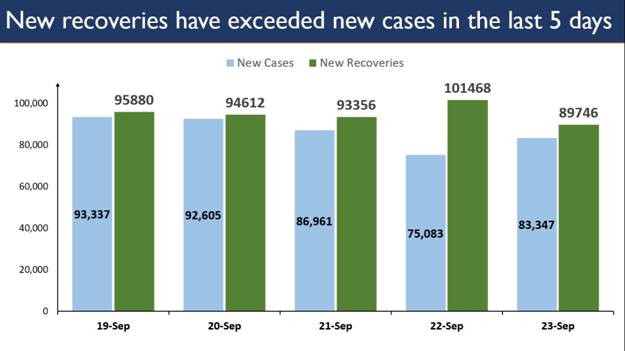
With this, the total number of recoveries are 45,87,613. The Recovery Rate is 81.25% today.
India has the highest recovered cases in the world. It contributes 19.5% to the global recoveries.
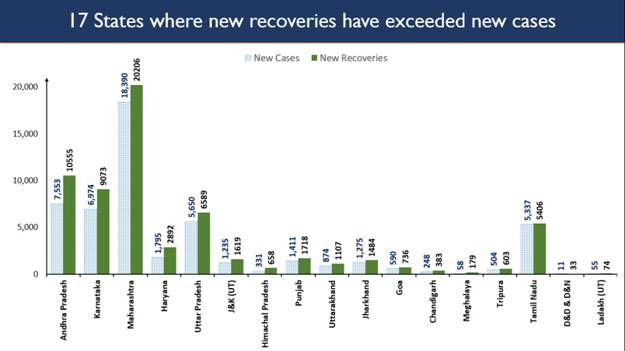
As India records more recoveries than the new cases, many States/UTs follow the suit.
17 States/UTs have more new recoveries than new cases.
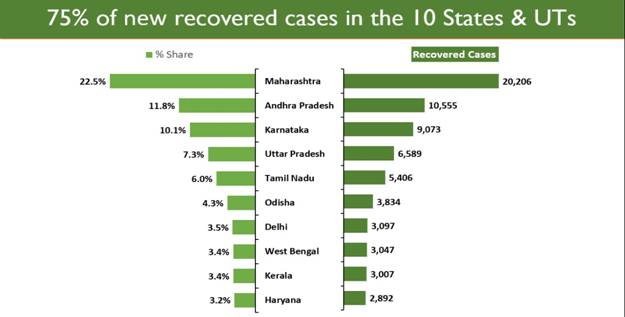
75% of the new recovered cases are being reported from ten States/UTs, viz. Maharashtra, Karnataka , Andhra Pradesh, Uttar Pradesh and Tamil Nadu, Odisha, Delhi, Kerala, West Bengal and Haryana.
Maharashtra continues to lead with more than 20,000 new cases of recovered patients. Andhra Pradesh contributed more than 10,000 to the single day recoveries.
****
MV/SJ
Monday, 21 September 2020
India reports more than 90,000 recoveries for the 3rd successive day
India reports more than 90,000 recoveries for the 3rd successive day
Total Recovered cases close to 43 Lakh- highest in the world
India's Recovery Rate crosses the landmark of 80%
Posted On:
21 SEP 2020 11:33AM by PIB Delhi
India has crossed the significant landmark of more than 80% national Recovery Rate.
On a continuous stretch of high recoveries, India has also reported more than 90,000 recoveries for the third day in succession.
93,356 patients were discharged in the last 24 hours.

12 States and UTs have registered Recovery Rate more than the national average.

79% of the new recovered cases are from 10 states/UTs.
The total recovered cases are close 44 lakh (43,96,399) today. India tops the global figure of total recoveries. It accounts for more than 19% of the world total.
Indian Tsunami Early Warning Centre is providing Tsunami Services to 25 Indian Ocean Countries: Dr. Harsh Vardhan
Indian Tsunami Early Warning Centre is providing
Tsunami Services to 25 Indian Ocean Countries: Dr. Harsh Vardhan
Posted On:
21 SEP 2020 6:59PM by PIB Delhi
The objectives of O-SMART (Ocean Services, Modelling, Applications, Resources and Technology) scheme of Ministry of Earth Sciences (MoES), Govt. of India are
(1) To generate and regularly update information on Marine Living Resources and their relationship with the physical environment in the Indian Exclusive Economic Zone (EEZ),
(2) To periodically monitor levels of sea water pollutants for health assessment of coastal waters of India, to develop shoreline change maps for assessment of coastal erosion due to natural and anthropogenic activities,
(3) To develop a wide range of state-of-the art ocean observation systems for acquisition of real-time data from the seas around India,
(4) To generate and disseminate a suite of user-oriented ocean information, advisories, warnings, data and data products for the benefit of society,
(5) To develop high resolution models for ocean forecast and reanalysis system,
(6) To develop algorithms for validation of satellite data for coastal research and to monitor changes in the coastal research,
(7) Acquisition of 2 Coastal Research Vessels (CRVs) as replacement of 2 old CRVs for coastal pollution monitoring, testing of various underwater components and technology demonstration,
(8) To develop technologies to tap the marine bio resources,
(9) To develop technologies generating freshwater and energy from ocean,
(10) To develop underwater vehicles and technologies,
(11) Establishment of Ballast water treatment facility,
(12) To support operation and maintenance of 5 Research vessels for ocean survey/monitoring/technology demonstration programmes,
(13) Establishment of state of the art sea front facility to cater to the testing and sea trial activities of ocean technology,
(14) To carryout exploration of Polymetallic Nodules (MPN) from water depth of 5500 m in site of 75000 sq.km allotted to India by United Nations in Central Indian Ocean Basin, to carryout investigations of gas hydrates,
(15) Exploration of polymetallic sulphides near Rodrigues Triple junction in 10000 sq. km of area allotted to India in International waters by International Seabed Authority/UN and,
(16) Submission of India's claim over continental shelf extending beyond the Exclusive Economic Zone supported by scientific data, and Topographic survey ofEEZ ofIndia.
The Indian Tsunami Early Warning Centre (ITEWC) was established at Indian National Centre for Ocean Information Services (INCOIS), Hyderabad, an autonomous body under Ministry of Earth Sciences which continues to provide timely tsunami advisories to stake holders. The ITEWC is also providing tsunami services to 25 Indian Ocean Countries as part of the Intergovernmental Oceanographic Commission (IOC) of UNESCO framework. INCOIS has introduced several innovative concepts in tsunami modeling, mapping of coastal inundation, Decision Support System, SOPs to meet the emerging challenges and provide accurate and timely tsunami early warnings. INCOIS has established a Global Navigation Satellite System (GNSS) & Strong Motion Accelerometers in Andaman and Nicobar Islands for quick and reliable estimation of source parameters for near source earthquakes. In addition, INCOIS has carried out Multi-hazard Vulnerability Mapping (MHVM) along the mainland of Indian coastland MHVM atlas has been prepared. The ITEWC, INCOIS regularly conducts workshops, training sessions and tsunami mock exercises to create awareness and preparedness about the tsunamis. In addition to workshops and trainings for disaster managers, ITEWC is also coordinating with coastal States/UTs to implement Tsunami Ready Programme, a concept introduced by UNESCO, at community level. Odisha has implemented the programme in two villages (Venkatraipur and Noliasahi) and based on the national board recommendation, IOC (UNESCO) recognized these villages as Tsunami ready communities.
We have better Tsunami prediction models at ITEWC and INCOIS is continuously working towards improving its accuracy.
Increasing Farmers’ Income
Increasing Farmers’ Income
Posted On:
21 SEP 2020 2:16PM by PIB Delhi
The Government constituted an Inter-ministerial Committee in April, 2016 to examine issues relating to “Doubling of Farmers Income” and recommend strategies to achieve the same. The Committee submitted its Report to the Government in September, 2018 containing the strategy for doubling of farmers’ income by the year 2022.The DFI strategy as recommended by the Committee include seven sources of income growth viz., (i) improvement in crop productivity; (ii) improvement in livestock productivity; (iii) resource use efficiency or savings in the cost of production; (iv) increase in the cropping intensity; (v) diversification towards high value crops; (vi) improvement in real prices received by farmers; and (vii) shift from farm to non-farm occupations. After acceptance of the DFI Committee recommendations, the Government has constituted an ‘Empowered Body’ to review and monitor the progress.
Agriculture being a State subject, the State Governments undertake implementation of programs/schemes for the development of the sector. Government of India supplements the efforts of the State Governments through various schemes/ programs. These schemes/ programs of the Government of India are meant for the welfare of farmers by increasing production, remunerative returns and income support to farmers. A list of initiatives taken by the Government are at Annexure.
The Department of Agriculture, Cooperation and Farmers’ Welfare is implementing RKVY scheme in the States which provides flexibility to the States for preparing projects for the promotion of more beneficial crops. These projects are approved by the State Level Sanctioning Committee under the Chairmanship of the Chief Secretary of the State. In addition DAC&FW provides support for the promotion of Commercial Crops like Sugarcane, Cotton, and Jute etc. under NFSM scheme and Horticulture Crops under MIDH to enhance the income of the farmers. Besides a crop diversification programme, as a sub-scheme of RKVY, is being implemented in the States of Punjab, Haryana and western Uttar Pradesh to replace Paddy with alternative crops like Oil Seeds, Pulses, Cotton and Maize etc.
The Government has taken following measures to promote the farming of dates in drought prone area and dry weather area:
- Under the Mission for Integrated Development of Horticulture, assistance is provided for establishment of Tissue Culture Lab @ 40% of cost to private sector and 100% of total cost to public sector (cost norms Rs.250.00 lakh/unit) for multiplication of Tissue Culture Plant of Date palm.
- National Horticulture Board provides assistance for Date palm cultivation under the component of Development of Commercial Horticulture on demand driven basis.
- Central Institute for Arid Horticulture (CIAH) under ICAR encourages planting of date palm in dry parts of the country where irrigation facilities are available for successful cultivation of date palm and impart training to farmers on production technologies of date palm, pollination and packaging etc. in selected districts of Rajasthan, Gujarat, Punjab, Haryana and Tamil Nadu.
This information was given in a written reply by the Union Minister of Agriculture and Farmers Welfare Shri Narendra Singh Tomar in Lok Sabha yesterday.
****
APS/SG/RC
Annexure
List of various interventions and schemes launched for the benefit of farmers.
(i) With a view to provide income support to all farmers’ families across the country, to enable them to take care of expenses related to agriculture and allied activities as well as domestic needs, the Central Government started a new Central Sector Scheme, namely, the Pradhan Mantri Kisan Samman Nidhi (PM-KISAN). The scheme aims to provide a payment of Rs. 6000/- per year, in three 4-monthly installments of Rs. 2000/- to the farmers families, subject to certain exclusions relating to higher income groups.
(ii) Further with a view to provide social security net for Small and Marginal Farmers (SMF) as they have minimal or no savings to provide for old age and to support them in the event of consequent loss of livelihood, the Government has decided to implement another new Central Sector Scheme i.e. Pradhan Mantri Kisan MaanDhan Yojana (PM-KMY) for providing old age pension to these farmers. Under this Scheme, a minimum fixed pension of Rs. 3000/- will be provided to the eligible small and marginal farmers, subject to certain exclusion clauses, on attaining the age of 60 years.
(iii) With a view to provide better insurance coverage to crops for risk mitigation, a crop insurance scheme namely Pradhan Mantri Fasal Bima Yojana (PMFBY) was launched from Kharif 2016 season. This scheme provides insurance cover for all stages of the crop cycle including post-harvest risks in specified instances, with low premium contribution by farmers.
(iv) Giving a major boost for the farmer’s income, the Government has approved the increase in the Minimum Support Price (MSPs) for all Kharif & Rabi crops for 2018-19 season at a level of at least 150 percent of the cost of production.
(v) Implementation of flagship scheme of distribution of Soil Health Cards to farmers so that the use of fertilizers can be rationalized.
(vi) “Per drop more crop” initiative under which drip/sprinkler irrigation is being encouraged for optimal utilization of water, reducing cost of inputs and increasing productivity.
(vii) “Paramparagat Krishi Vikas Yojana (PKVY)” for promoting organic farming.
(viii) Launch of e-NAM initiative to provide farmers an electronic transparent and competitive online trading platform.
(ix) Under “Har Medh Par Ped”, agro forestry is being promoted for additional income. With the amendment of Indian Forest Act, 1927, Bamboo has been removed from the definition of trees. A restructured National Bamboo Mission has been launched in the year 2018 to promote bamboo plantation on non forest government as well as private land and emphasis on value addition, product development and markets.
(x) Giving a major boost to the pro-farmer initiatives, the Government has approved a new Umbrella Scheme ‘Pradhan Mantri Annadata Aay Sanrakshan Abhiyan (PMAASHA)’. The Scheme is aimed at ensuring remunerative prices to the farmers for their produce as announced in the Union Budget for 2018. This is an unprecedented step taken by Govt. of India to protect the farmers’ income which is expected to go a long way towards the welfare of farmers.
(xi) Bee keeping has been promoted under Mission for Integrated Development of Horticulture (MIDH) to increase the productivity of crops through pollination and increase the honey production as an additional source of income of farmers.
(xii) To ensure flow of adequate credit, Government sets annual target for the flow of credit to the agriculture sector, Banks have been consistently surpassing the annual target. The agriculture credit flow target has been set at Rs. 13.50 lakh crore for the F.Y.2019-20 and Rs.15.00 lakh crore for F.Y. 2020-21.
(xiii) Extending the reach of institutional credit to more and more farmers is priority area of the Government and to achieve this goal, the Government provides interest subvention of 2% on short-term crop loans up to Rs.3.00 lakh. Presently, loan is available to farmers at an interest rate of 4% per annum on prompt repayment.
(xiv) Further, under Interest Subvention Scheme 2018-19, in order to provide relief to the farmers on occurrence of natural calamities, the interest subvention of 2% shall continue to be available to banks for the first year on the restructured amount. In order to discourage distress sale by farmers and to encourage them to store their produce in warehouses against negotiable receipts, the benefit of interest subvention will be available to small and marginal farmers having Kisan Credit Card for a further period of upto six months post harvest on the same rate as available to crop loan.
(xv) The Government has extended the facility of Kisan Credit Card (KCC) to the farmers practicing animal husbandry and fisheries related activities. All processing fee, inspection, ledger folio charges and all other services charges have been waived off for fresh renewal of KCC. Collateral fee loan limit for short term agri-credit has been raised from Rs.1.00 lakh to Rs.1.60 lakh. KCC will be issued within 14 days from the receipt of completed application.
(xvi) Several market reforms have been rolled out. These include
- Model APLMC (Promotion & Facilitation) Act, 2017
- Establishment of 22,000 number of Gramin Agriculture Markets (GrAMs) as aggregation platforms
- Agri-Export Policy, that targets to double agri-exports by 2022
- The Farmers Produce Trade and Commerce (Promotion & Facilitation) Ordinance, 2020
- The Farmers (Empowerment & Protection) Agreement on Price Assurance and Farm Services Ordinance, 2020
- Amendments to Essential Commodities Act, 1955, that deregulates various agri-commodities
- Promotion of 10,000 FPOs by 2024
(xvii) Creation of Corpus Funds
- Micro Irrigation Fund – Rs. 5,000 crores
- Agri-marketing Fund to strengthen eNAM and GrAMs – Rs. 2,000 crores
- Agricultural Infrastructure Fund (AIF) to build agri-logistics (backward & forward linkages) – Rs. 1 lakh crores
Subscribe to:
Posts (Atom)