Monday, 2 November 2026

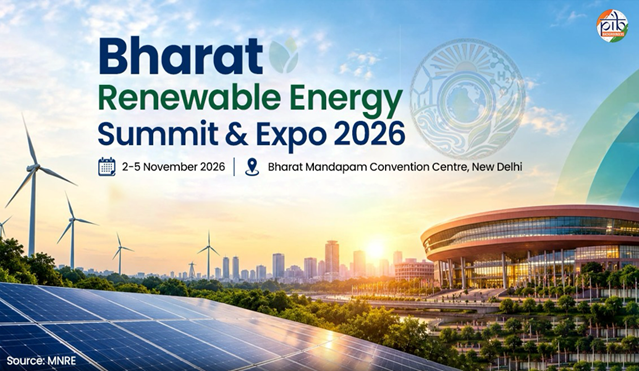
The prestigious Bharat Renewable Energy Summit & Expo 2026 is being held from 2 to 5 November 2026 at the Bharat Mandapam Convention Centre in New Delhi. Formally continuing India's well-known RE-INVEST series, this mega event co-hosts three paramount clean-energy platforms: the 9th Session of the International Solar Alliance (ISA) Assembly, the 4th International Conference on Green Hydrogen (ICGH), and the flagship RE Expo itself.

 The prestigious Bharat Renewable Energy Summit & Expo 2026 is being held from 2 to 5 November 2026 at the Bharat Mandapam Convention Centre in New Delhi. Formally continuing India's well-known RE-INVEST series, this mega event co-hosts three paramount clean-energy platforms: the 9th Session of the International Solar Alliance (ISA) Assembly, the 4th International Conference on Green Hydrogen (ICGH), and the flagship RE Expo itself. 

The exhibition features over 400 global manufacturers, developers, and technology providers, with leading industries gathering to demonstrate capabilities across wind, solar, and hybrid infrastructure. 

Major Renewable Energy Industries at the Event
The comprehensive lineup of major industrial participants and stakeholders represented or participating at the event includes:
  • Greenko Group: India's pioneer in dispatchable renewables and largest clean energy storage operator, showcasing their signature gigawatt-scale pumped hydro storage projects.
  • Adani Green Energy: Presenting massive utility-scale solar and wind generation portfolios.
  • Tata Power Renewable Energy: Spotlighting extensive grid-tied solar, hybrid parks, and distributed clean tech.
  • NTPC Green Energy Ltd (NGEL): Public sector power giant scaling up solar and green hydrogen infrastructure.
  • ReNew: Demonstrating large-scale asset development across wind, solar, and corporate decarbonisation options.
  • Suzlon Energy & Inox Wind: Wind energy manufacturing pioneers leading the domestic supply-chain shift.
  • Sterling and Wilson Renewable Energy: Specialized global solar EPC and engineering heavyweights.
  • Avaada Energy & Azure Power: Independent power producers advancing global solar utility footprints.
  • Ampin Energy Transition & Hero Future Energies: Commercial & Industrial (C&I) decarbonisation specialists. 

Focus Feature: Greenko Group Profile
As a principal industry entity in India's energy transition, Greenko Group plays an anchor role in the themes driving the summit (Digitalisation, AI, and Storage). 
  • Current Operational Footprint: Commands an installed capacity of 11 GW, with an active pipeline aiming to hit 50 GW by 2030.
  • Storage Leadership: Currently manages over 20 GWh of daily operational storage capacity (expanding to 100 GWh by 2030), headlined by the world's largest integrated pumped hydro storage projects. 
  • Environmental Impact: Avoids an estimated 59.05 million tonnes of CO2 emissions annually while powering over 1.83 crore households across India. 
If you are attending the event or looking to interface directly with Greenko or other industrial booths, the prominent touchpoints include:
  • Greenko Group (HQ)
    • Core Role: Main corporate headquarters driving digitization, pumped storage, and carbon-free energy orchestration.
    • Location: Hitech City Layout, Madhapur, Hyderabad, Telangana. 
  • Greenko Group (Delhi Corporate Office)
    • Core Role: Strategic northern regional office coordinating key public-private partnerships, transmission projects, and G2G relations.
    • Location: 15th Floor, Hindustan Times House, KG Marg, New Delhi. 
    he complete exhibition layout for the Bharat Renewable Energy Summit & Expo 2026 is distributed across Halls 1 to 5 on the Ground Floor of Bharat Mandapam, spanning roughly 32,000 square metres. [1, 2, 3]
    As one of the anchor developers showcasing gigawatt-scale pumped storage and green hydrogen pathways, Greenko's massive custom raw space pavilion is centrally positioned within the primary industry zones. [1, 2, 3]
    The digital assets and interactive layouts are available directly through the official platform channels:
    ЁЯЧ║️ Visualizing the Floor Layout
    • Interactive Grid: You can navigate the complete zoning, check adjacent state/country pavilions, and track booth distributions using the Official BRE Summit Floor Plan. The desktop layout allows you to hover over specific blocks to zoom in on booth numbers and coordinates. 
    • PDF Schematic: For a blueprint showing technical details like structural columns, entry/exit gates, and cargo service roads, you can view the BRE Summit 2026 Floor Plan PDF. [
    ЁЯУ▒ Live Navigation at Bharat Mandapam
    Because the event is currently active, booth layouts, live traffic, and company-specific desk setups are best tracked via mobile. You can download the official BRE Summit 2026 Mobile App available via the BRE Summit Floor Plan Page to pull up real-time indoor GPS navigation straight to Greenko's booth

Khet Bachaao Abhiyaan - Rabi 2026 “Soil Health and Sustainable Agriculture”


Khet Bachaao Abhiyaan - Rabi 2026


“Soil Health and Sustainable Agriculture”

Posted On: 02 NOV 2026 10:47AM by PIB Delhi

Khet Bachaao Abhiyaan (KBA)-Rabi 2026 is a nationwide campaign running from 22 October to 30 November 2026. It promotes soil health, balanced fertiliser use, and sustainable agriculture across 34 States and Union Territories, over 700 districts and 50,000 villages, targeting around 50 lakh farmers. Key priorities include balanced nutrient management, natural farming, crop residue management, crop diversification and climate-resilient agriculture. The campaign envisages 4,150 teams involving KVKs and ATMA, supported by over 12,000 scientists and ATMA functionaries. The initiative seeks to conduct 50,000 field demonstrations and 11,750 structured training sessions. The campaign projects a social media outreach of 1.5 crore farmers, with an envisaged expansion of overall digital outreach to 2.5 crore.


The Foundation of Farming Lies Beneath

Soil health is fundamental to agricultural productivity, food security, and rural livelihoods. With more than 46 percent of India’s workforce engaged in agriculture and allied activities, soil health influences food systems and economic stability. Healthy soils support higher crop yields and reduce dependence on external inputs.

Recognising the importance of soil health, Khet Bachaao Abhiyaan (KBA) - Rabi 2026 “Swasth Dhara, Samriddh Kisan” is envisaged as a nationwide campaign from 22 October to 30 November 2026. It follows a convergence-based approach, bringing together agricultural departments, research institutions, and field-level functionaries to promote balanced, judicious fertiliser use and sustainable nutrient management. The campaign aims to promote sustainable agriculture, improve soil health, and encourage the judicious use of agricultural resources. It also promotes natural farming, water conservation, and efficient use of natural resources. It addresses concerns such as imbalanced nutrient application, declining soil organic matter, rising cultivation costs, and the degradation of natural resources.

The initiatives also emphasise capacity building, farm mechanisation, and demonstrations of improved agricultural technologies, including regenerative agriculture practices (farming methods focused on restoring soil health and enhancing biodiversity).

The campaign covers 34 States and Union Territories, over 700 districts and 50,000 villages. It aims to reach around 50 lakh farmers through coordinated activities. States and Union Territories have been instructed to prioritise 100 high fertiliser-consuming districts to strengthen outreach and promote balanced nutrient management.  

Through its wide reach and field-level activities, the campaign seeks to bring farmers, scientists and agricultural institutions together. This coordinated effort is expected to encourage informed farming decisions and greater adoption of sustainable agricultural practices.


Khet Bachaao Abhiyaan

(From 1 to 30 June 2026)

Khet Bachaao Abhiyaan was launched nationwide on 1 June 2026 as a month-long campaign to promote soil health, balanced fertiliser use and sustainable agricultural practices. The campaign deployed 1,657 multidisciplinary teams for direct field-level engagement. The initiative achieved significant outreach, conducting over 1.34 lakh awareness events for 92.44 lakh farmers, and 6,685 training sessions on green manuring and bio-fertilisers, benefiting 4.94 lakh farmers. Additionally, 3,167 field demonstrations and 4,779 interactive programs provided hands-on learning. A further 4,916 Janpratinidhi Sammelans, including those involving fertiliser and input dealers, strengthened grassroots engagement.. Overall, the campaign directly reached around 1.07 crore farmers and other stakeholders, while social media outreach covered approximately 4.5 crore citizens.

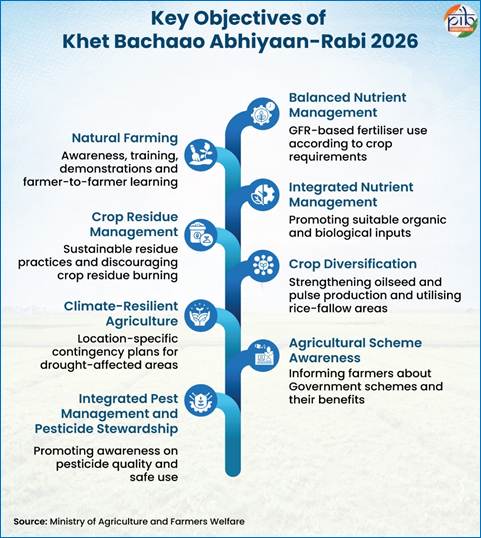
Key Objectives of Khet Bachaao Abhiyaan - Rabi 2026

The campaign aims to encourage farmers to adopt location-specific, science-based practices that improve input-use efficiency and support climate-resilient agriculture.

  • Balanced Nutrient Management: Promote General Fertiliser Recommendations (GFR) based nutrient management and the 4R Principle of fertiliser use -  Right source, Right rate, Right time, and Right place. This method ensures balanced, efficient fertiliser use aligned with Rabi crop requirements.
  • Natural Farming: Encourage the adoption of natural farming through awareness campaigns, capacity building, demonstrations and farmer-to-farmer learning.
  • Integrated Nutrient Management (INM): Promote INM and the use of suitable organic and biological inputs through awareness, capacity building and demonstrations.
  • Crop Residue Management: Promote sustainable residue management and discourage crop residue burning in Punjab, Haryana, Uttar Pradesh and Madhya Pradesh through Information, Education and Communication (IEC) activities.
  • Crop Diversification: Strengthen oilseed and pulse production, encourage crop diversification and promote the productive use of rice-fallow areas through awareness, capacity building and demonstrations.
.

  • Climate-Resilient Agriculture: Implement location-specific contingency plans in drought-affected areas of Maharashtra, Karnataka, Telangana, Andhra Pradesh and Rajasthan to support climate-resilient crop and resource management.
  • Awareness of Agricultural Schemes: Create awareness about government schemes related to agriculture and their benefits.
  • Integrated Pest Management and Pesticide Stewardship: Promote awareness of pesticide quality and safe use, encourage Integrated Pest Management (IPM) and safe, need-based, label-compliant pesticide use, and discourage indiscriminate application.


Dhaincha and Green Gram Offer a Path to Healthier Soils

In the rice-growing areas of East Champaran, Bihar, maintaining soil fertility while managing fertiliser use is an important concern for farmers. Declining soil organic carbon and micronutrient deficiencies add to the challenge. Under Khet Bachaao Abhiyaan-2026, the ICAR-Mahatma Gandhi Integrated Farming Research Institute (MGIFRI), Motihari, Bihar, highlighted how green manuring and biological nitrogen fixation can support soil health.

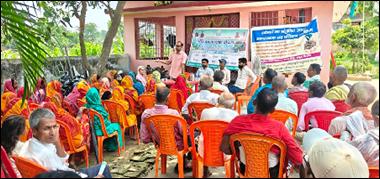
At the farmer outreach programme at the Pantoka Panchayat in Raxaul Block, East Champaran District, Bihar, farmers were encouraged to combine farmyard manure, compost, biofertilisers and crop residues with recommended fertiliser doses. The discussions covered rice nursery management and alternatives to crop residue burning, including composting, mulching and vermicomposting.
.

Scientists also emphasised the use of dhaincha (Sesbania sp.) and summer green gram in rice-based cropping systems. Dhaincha can contribute around 50-60 kg of nitrogen per hectare, equivalent to 110-130 kg of urea. Summer green gram can contribute 25-30 kg of nitrogen per hectare, equivalent to 55-65 kg of urea. These crops can help reduce fertiliser requirements while improving soil organic matter and biological activity.

The programme brought together 62 farmers, including 41 women. Participants expressed willingness to adopt green manuring and balanced nutrient management.

Bringing the Campaign to Farmers: Institutional Roles and Responsibilities

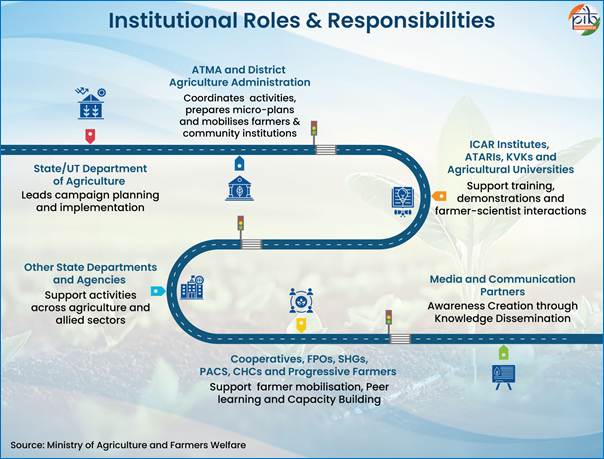
  • State/UT Department of Agriculture: Responsible for campaign planning and implementation, issuing necessary instructions, convening preparatory meetings, approving district-level schedules, mobilising field personnel and convergence partners, facilitating access to schemes and services, and consolidating reports.
  • Agricultural Technology Management Agencies (ATMA) and District Agriculture Administration: Responsible for coordinating campaign activities across district, block and village levels, preparing micro-plans, mobilising farmers and community institutions, facilitating venues, field access, IEC materials and logistics, and maintaining attendance and activity records.
  • ICAR Institutes, Agricultural Technology Application Research Institutes (ATARIs), Krishi Vigyan Kendras (KVKs), and Agricultural Universities (Knowledge Partners): Provide science-based technical guidance and location-specific recommendations, nominate resource persons, support training, conduct demonstrations and farmer-scientist interactions when requested, prepare or validate technical IEC materials and advisories, share research evidence, and document lessons. Their role does not extend to State-level implementation, administrative control, enforcement or expenditure responsibilities unless separately authorised.


The campaign envisages 4,150 teams involving KVKs and ATMA. More than 12,000 scientists and ATMA functionaries are expected to help implement it. Through ATMA and ICAR, the campaign aims to reach approximately one crore participants.
.

  • Other State Departments and Agencies: Support and facilitate campaign activities, as relevant to their respective mandates, through coordinated engagement by departments and agencies responsible for horticulture, soil and water conservation, irrigation, animal husbandry, rural development, cooperatives, Panchayati Raj, environment, agricultural marketing and allied sectors.
  • Farmer Producer Organisations (FPOs), Self-Help Groups (SHGs), Primary Agricultural Credit Societies (PACS), Custom Hiring Centres (CHCs) and Progressive Farmers: Support local mobilisation, peer learning, demonstration visits and dissemination of validated advisories among farmers.
  • Media and Communication Partners: Facilitate the dissemination of approved campaign messages through local media, community radio, WhatsApp, Kisan Sarathi and other appropriate communication platforms, while ensuring the accuracy and verification of agronomic information shared with farmers.

Driving Farmer Awareness and Outreach

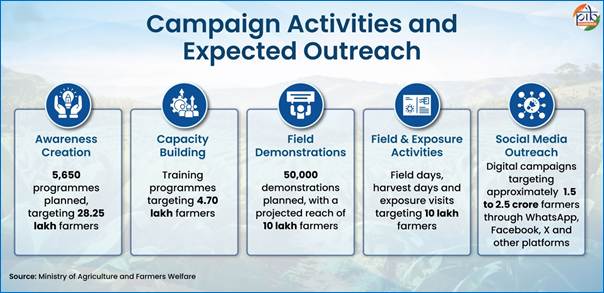
The campaign combines farmer awareness, capacity building, field demonstrations, practical exposure visits, and digital outreach to promote improved agricultural practices, strengthen technical knowledge, and extend the reach of campaign messages among farmers.
.

Awareness Creation for Various Activities

The campaign seeks to enhance farmers’ awareness and understanding of General Fertiliser Recommendations GFR-based nutrient management, natural farming, Integrated Nutrient Management (INM), Crop Residue Management (CRM), and improved technologies for oilseed and pulse production. It also disseminates information on Standard Operating Procedures (SOPs) for implementing contingency plans in drought-affected districts and key government schemes related to agriculture.

  • Each of the 950 ICAR institute teams is assigned three village visits per week, while the 700 KVK teams are expected to undertake four visits per week. Each visit targets the participation of 100 farmers.
  • Over a five-week period, the campaign envisages 5,650 awareness programmes, with an estimated outreach of 28.25 lakh farmers.

Capacity Building of Farmers

Training programmes are designed to strengthen farmers’ knowledge and technical capacities in Integrated Nutrient Management (INM), Crop Residue Management (CRM), natural farming, improved oilseed and pulse production practices, Integrated Pest Management (IPM), and other relevant thematic areas.

  • Each of the 950 ICAR institute teams is expected to conduct one training programme per week, while the 700 KVK teams are assigned two programmes per week. Each programme targets 40 participants.
  • Over a five-week period, the campaign envisages 11,750 training programmes, with an estimated outreach of 4.70 lakh farmers.

Demonstrations at Farmers’ Fields

ICAR institutes and Krishi Vigyan Kendras (KVKs) organise field demonstrations at selected farmers’ fields to illustrate the potential and benefits of improved agricultural technologies. These demonstrations enable farmers to assess scientific interventions and compare their outcomes with existing farming practices. The key areas covered include Green Ammonia, Crop Residue Management (CRM), Integrated Nutrient Management (INM), Integrated Pest Management (IPM), natural farming, Integrated Crop Management (ICM) for oilseeds and pulses, biofertilisers, and organic and biological inputs.

  • The campaign envisages 50,000 field demonstrations, comprising 40,000 by KVKs and 10,000 by ICAR institutes.
  • With an intended participation of 20 farmers per demonstration, the initiative targets an estimated outreach of 10 lakh farmers.

Field Days, Harvest Days and Exposure Visits

Field days, harvest events and exposure visits to demonstration sites constitute an integral component of the campaign’s “Seeing is Believing” approach. These activities provide farmers with first-hand opportunities to observe improved agricultural technologies, understand their practical applications and assess their benefits under field conditions.

  • Each of the 1,650 teams is assigned to organise three field or harvest days and two exposure visits during the crop season, with each activity targeting approximately 125 farmers.
  • These activities are expected to collectively reach approximately 10 lakh farmers.

Social Media Outreach

Digital platforms serve as an important channel for disseminating information on improved agricultural practices, technical advisories, and campaign-related activities, thereby extending the campaign’s outreach beyond field-level interventions.

  • Organising teams to disseminate daily updates through WhatsApp, Facebook, X, and other appropriate digital platforms.
  • The campaign projects a social media outreach of 1.5 crore farmers, with an envisaged expansion of overall digital outreach to 2.5 crore.

Connecting Farmers with Schemes and Services

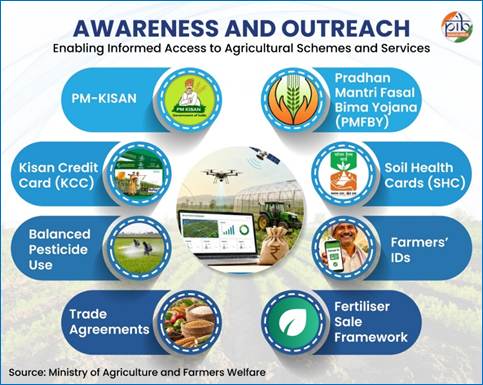
The campaign undertakes targeted awareness initiatives to familiarise farmers with key agricultural schemes, services and practices. These include PM-KISAN, balanced pesticide use, Soil Health Cards, the applicable fertiliser sale framework and the potential benefits of trade agreements. It also facilitates the creation and updating of Farmers’ IDs and disseminates information on crop insurance coverage under the Pradhan Mantri Fasal Bima Yojana (PMFBY). In addition, saturation drives under the Kisan Credit Card (KCC) scheme seek to facilitate eligible farmers’ access to institutional credit.
.

Collectively, these interventions seek to strengthen farmers’ awareness of government support mechanisms and improve their access to essential agricultural services, formal credit and risk-mitigation instruments, thereby reinforcing the institutional and financial foundations of farm livelihoods.

Strengthening the Foundations of Sustainable Agriculture

The Khet Bachaao Abhiyaan-Rabi 2026 seeks to place soil health and sustainable resource management at the centre of agricultural development. Through convergence among scientific institutions, government departments, extension networks and farming communities, it aims to translate scientific knowledge into location-specific agricultural practices. Its integrated approach combines farmer awareness, capacity building, field demonstrations and digital outreach to promote improved farming practices. Alongside balanced nutrient management, natural farming and efficient input use, the campaign emphasises crop diversification, residue management, integrated pest management and climate resilience. Its focus on institutional coordination and farmer participation also strengthens grassroots extension mechanisms and access to agricultural services.

These interventions support resource-efficient farming systems, healthier soils and resilient agricultural livelihoods, contributing to the broader vision of Viksit Bharat. Furthermore, the campaign supports progress towards the Sustainable Development Goals (SDGs), particularly Zero Hunger (SDG 2) and Climate Action (SDG 13).

Agri-Voltaics Powering India’s Farms, Growing a Sustainable Future


Agri-Voltaics


Powering India’s Farms, Growing a Sustainable Future

Posted On: 02 NOV 2026 3:40PM by PIB Delhi

At the intersection of agriculture and renewable energy lies an innovative approach to making farmland more productive. Agrivoltaics combines crop cultivation with solar power generation on the same land, enabling farmers to diversify their incomes while contributing to India’s clean energy transition. By bringing food production and solar electricity together, it offers a promising pathway towards efficient land use, greater farm resilience and sustainable rural prosperity.


Solar Power for Agri Farms and a Cleaner Future

Agriculture plays a vital role in India’s economy, serving as a key source of livelihood for approximately 46.1 per cent of the population. The Gross Value Added (GVA) of the Agriculture and Allied Sector is estimated to reachRs. 52.08 lakh crore in 2025-26. Sustaining this vital sector requires reliable and affordable energy for irrigation and other farming operations. Solar power can help meet these everyday needs while advancing India’s clean energy transition.Click to Read More: The New Era of Indian Agriculture and Allied Sectors

India’s vast agricultural land offers significant prospects to integrate solar energy with farming. According to Land Use Statistics for 2023-24, the country’s reported area covers 306.96 million hectares, of which approximately 55 per cent is agricultural land. The net sown area stands at 138.99 million hectares, while the gross cropped area covers 217.88 million hectares. This extensive land base offers opportunities to generate solar electricity alongside agricultural production. Farmers can use solar power to operate irrigation pumps, reduce dependence on conventional electricity and potentially supplementary revenueby supplying surplus electricity to the grid. For instance, solar-powered irrigation pumps can provide daytime power for watering crops while reducing reliance on diesel-powered alternatives.

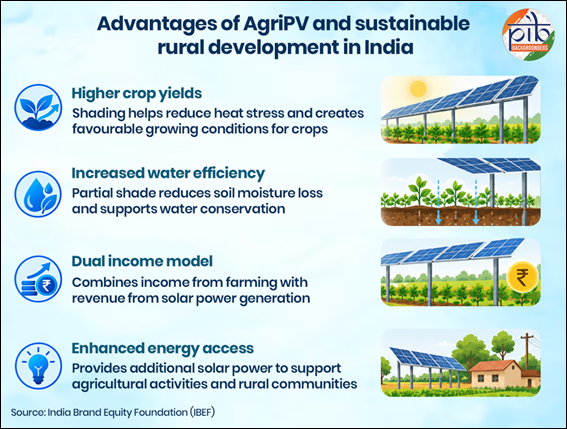
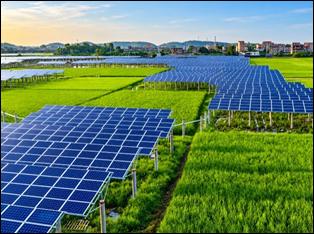
Agrivoltaics takes this integration further by bringing together crop cultivation and solar electricity generation on the same land. Solar panels installed above or between crop rows allow electricity generation alongside continued farming. Depending on the crop, panel design and local conditions, partial shading may also help reduce soil moisture loss. This approach can improve land-use efficiency, diversify farm earnings and strengthening both food and energy security. Through research, field demonstrations and policy development, India is exploring ways to adapt agrivoltaics to diverse agricultural conditions. It offers a promising pathway to align farmers’ livelihoods with India’s wider renewable energy ambitions.

The Bharat Renewable Energy Summit & Expo (Bharat RE) 2026 is being held from 2–5 November 2026 at Bharat Mandapam, New Delhi, under the theme ‘Invest. Innovate. Inspire.’ The four-day Summit brings together participants from over 130 countries, including more than 40 Ministers, policymakers, investors, financial institutions and industry leaders. Nine Countries- Australia, Denmark, the European Union, France, Germany, the Netherlands, Norway, Sweden and the United Kingdom will participate as Country Partners. 13 Indian States and Union Territories are participating, showcasing renewable energy potential, investment opportunities, and clean manufacturing capabilities. Key focus areas of the summit includes solar and wind energy, green hydrogen, energy storage, grid integration, domestic manufacturing, digitalisation and artificial intelligence applications in the energy sector. The Summit provides a global platform for clean energy investment, technology partnerships and industry collaboration. It features ministerial discussions, CEO roundtables, investor engagements and an exhibition featuring over 400 exhibitors. The event is being held alongside the 9th International Solar Alliance Assembly and the 4th International Conference on Green Hydrogen, strengthening international cooperation across the clean energy sector. Click to Read More: Bharat Renewable Energy Summit & Expo 2026


Agrivoltaics: Bridging Agriculture and Renewable Energy

Agrivoltaics, also known as agrisolar or dual-use solar, maximises land-use efficiency, provides shade for crops and creates additional benefits for farmers.

Design and Functioning of Agrivoltaic Systems

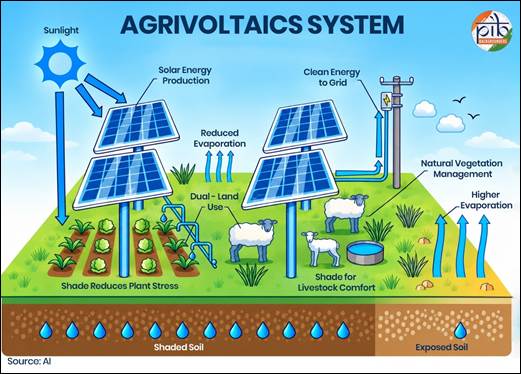
An agrivoltaic system integratesagricultural infrastructure with solar installations, adapted to local farming conditions. The technology operates through various key elements:

  • Elevated Solar Structures:Instead of placing solar panels directly on the ground, they are mounted on structures high enough to let sunlight and rain reach the crops below. These elevated solar panels for agriculture also allow farmers to move their equipment underneath without any trouble.
  • Partial shading:The panels provide shade, which helps protect crops from extreme heat and reduces water evaporation from the soil. This creates a cooler, more stable environment for plants to grow, especially in hot or dry regions.
  • Dual Land Productivity:Agrivoltaics optimises land use by integrating crop cultivation or livestock rearing with solar power generation, supplying electricity for farm activities and creating an additional revenue stream through surplus power sales to the grid.

Agrivoltaics Development in India

As of August 2025, India had 36 operational agrivoltaics projects with an installed capacity of 37.54 megawatts, alongside 10 pilot projects under development. These Projects span diverse agroclimatic regions and include elevated structures, interspace layouts and tracking systems, reflecting India’s evolving approach to integrating solar power generation with agricultural production.

India’s Agrivoltaic Potential

India holds significant potential for agrivoltaics. Estimates place the country’s agrivoltaic potential between 3,000 GW and nearly 14,000 GW, highlighting the scale of opportunity at the intersection of agriculture and renewable energy. Agrivoltaic systems can also create profits diversificationfor farmers. In some cases, annual earnings could rise from around Rs.60,000 per acre to over Rs.1 lakh per acre.


Scope for Agrivoltaics Developments

  • Land Suitability: The GIS-based national screening identified 47.35 million hectares of “restricted cropland” suitable for AgriPV after applying environmental, agronomic, and technical filters, reflecting a conservative, climate-resilient land base.
  • Crop Compatibility: Fruits, vegetables, spices and medicinal plants offer promising options for cultivation alongside solar installations.
  • High-potential statesinclude Maharashtra, Rajasthan, Andhra Pradesh, Madhya Pradesh, Karnataka and Uttar Pradesh, which collectively account for nearly 50 per cent of India’s estimated AgriPV power generation potential, driven by favourable combinationof cropland availability, solar resource, and agro-climatic conditions.
  • Moderate potentialis observed in Odisha, Tamil Nadu, Kerala, Telangana, Bihar, and West Bengal.
  • The southern, western, and central regions exhibit the most favourable combination of solar irradiance, land availability, and horticultural intensity for large-scale deployment.

Government Initiatives in Agrivoltaics Development

The Government of India has undertaken a range of policy, research, technology development, and implementation measures to advance agrivoltaics adoption and expansion across the country.

  • Pradhan Mantri Kisan Urja Suraksha evam Utthaan Mahabhiyan (PM KUSUM): Launched in February 2019, the scheme encourages solar energy adoption in agriculture, reduces dependence on diesel and creates opportunities for farmers to diversify their earnings. It envisages central financial assistance of approximately Rs.34,422 crore. It also enables decentralised solar power generation and solarisation of agricultural pumps, creating avenues of development for solar energy integration with farming. PM KUSUM Scheme
  • Centre of Excellence on Agrivoltaics: The National Institute of Solar Energy, in collaboration with the Indian Council of Agricultural Research’s Indian Agricultural Research Institute, has established a CoE for agrivoltaics research, demonstration and capacity building. It has undertaken pilot projects, including a 100-kilowatt agrivoltaic system at the Indian Agricultural Research Institute.


India Agrivoltaics Alliance

The India Agrivoltaics Alliance (IAA), anchored by the National Solar Energy Federation of India (NSEFI), is a multi-stakeholder platform advancing the dual use of land for solar energy generation and agriculture. Launched in 2023, the Alliance has grown to over 40 members and works with government ministries and industry stakeholders to advance agrivoltaics through policy advocacy, research and on-the-ground implementation. It develops knowledge resources, promotes pilot projects and supports scalable business models to improve land productivity, diversify farmer incomes and strengthen rural energy access.


State-specific Initiatives

Several states are facilitating solar energy in agriculture through region-specific schemes.

  • Mukhyamantri Saur Krushi Vahini Yojana 2.0, Maharashtra:The scheme drives solar power generation through 16,000 megawatts of solar projects across approximately 35,000 acres of government and private land to support electricity supply to agricultural consumers.
  • Kisan Suryoday Yojana, Gujarat:Expands solar energy utilisation to meet farmers’ electricity needs by providing daytime power supply for agricultural activities, with a planned supply window of up to 16 hours daily, from 5:00 AM to 9:00 PM, through the phased commissioning of solar and other non-conventional energy generation plants.
  • Surya Raitha Scheme, Karnataka: The scheme advances solar-powered irrigation pumps and allows farmers to earn from surplus electricity. Solar pumps can help farmers access energy for watering their crops while reducing dependence on diesel-powered pumps.

The Government of India, alongside state governments, is advancing the use of solar energy in agriculture through policy measures and targeted programmes. These efforts are shaping India’s agrivoltaics landscape by creating opportunities for the co-location of solar power generation and agricultural production.

Powering Prosperity Through the Convergence of Farms and Clean Energy

Agrivoltaics offers India an opportunity to strengthen agricultural livelihoods while advancing environmental sustainability. By combining food production with renewable energy generation, it can offer scope for more efficient land use, conserve water under suitable conditions and create greater financial resilience. The Government of India’s initiatives, including PM-KUSUM and proposed measures to expand agrivoltaics, reflect efforts to connect rural development with clean energy goals. As implementation grows, locally suitable designs, scientific research and farmer participation will be essential to balance agricultural productivity with energy needs. This approach can contribute to a more resilient and sustainable future for India.Greater financial resilience

References

Ministry of New and Renewable Energy