Parvat Manthan Conclave 2026 concludes with recommendations to strengthen climate resilience, ecological planning and municipal finance in Himalayan cities
Two-day Regional Conclave brings together representatives from 11 Himalayan states to address integrated water and sanitation management, climate resilience and ecosystem-based urban development
Ten initiatives, publications and learning resources launched; 18 innovative urban solutions recognised under अrban Learnathon 2.0
The Parvat Manthan Conclave 2026, convened by the National Institute of Urban Affairs (NIUA), concluded today in Dehradun, Uttarakhand, with recommendations to strengthen urban resilience, ecological planning and sustainable service delivery across the Indian Himalayan Region. The two-day Conclave, held from 17 to 18 November 2026, brought together policymakers, representatives from Himalayan states, urban local bodies, technical experts, academia, civil society organisations and development partners to deliberate on the distinct challenges of mountain urbanisation and identify practical approaches for resilient and sustainable urban development.
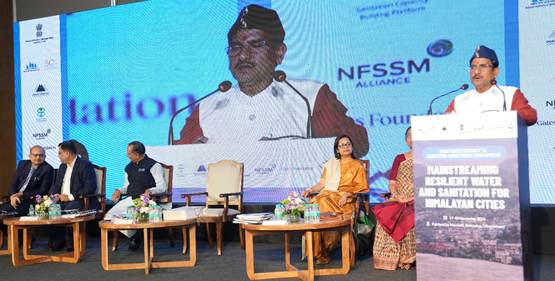
The Conclave was inaugurated on 17 November 2026 by Shri Tokhan Sahu, Hon’ble Minister of State for Housing and Urban Affairs, Government of India, under the theme ‘From Water Security to Ecosystem-Based Urban Development: Mainstreaming Resilient Water and Sanitation for Himalayan Cities’.
Delivering the inaugural address, Shri Tokhan Sahu emphasised the importance of regional cooperation, institutional capacity building and knowledge-sharing in addressing the challenges faced by Himalayan cities. Stating that “by pooling knowledge, strengthening local capacities and learning from each other, we can advance solutions for water security, inclusive urban services and dignified sanitation, recognising that challenges do not stop at geographical boundaries”, he called for stronger collaboration among governments, institutions and regional stakeholders. Highlighting the importance of replicating successful urban innovations, he observed that “a solution confined to one city benefits only that city, but a solution shared and replicated has the potential to transform a hundred cities”.
Shri Nitesh Jha, Secretary, Urban Development, Government of Uttarakhand noted that as the source of the Ganga, the Yamuna and other major rivers, Uttarakhand bears a responsibility to every town and village downstream. For this reason, he said, the state treats the management of used water and faecal sludge as a commitment rather than a municipal chore. Tracing the state-led partnership with NIUA since 2019, he highlighted the Septage Management Protocol of 2017 and the co-treatment of septage at existing sewage treatment plants in Ganga towns. He also cited Rudrapur’s faecal sludge treatment plant, the first standalone facility in the state, which was built with support from NIUA. He called on partners, Union ministries and hill states to help design norms and financing that recognise the realities of mountain terrain.
Ms Nameeta Prasad, Joint Secretary, Ministry of Environment, Forest and Climate Change (MoEFCC), described the Himalayan region as the water tower of Asia, observing that its water crisis stems not from scarcity but from declining springs, pollution, inadequate infrastructure and growing urban demand. Emphasising that Himalayan cities cannot be water secure unless their surrounding ecosystems are healthy, she called for water security to be addressed within a wider ecological framework rather than through centralised infrastructure alone. She highlighted the National Mission on Himalayan Studies (NMHS) as a key platform in this effort, noting that it has supported over 255 projects, including more than 40 on water resource management.
Prof. (Dr) Debolina Kundu, Director, NIUA, highlighted the evolution of Parvat Manthan into a community of practice that brings together mountain states, institutions and regional partners to exchange knowledge, strengthen capacities and develop practical solutions. She noted that the platform has facilitated peer learning, regional cooperation and policy dialogue to support more responsive approaches to the unique challenges of mountain urbanisation.
Shri Vinod Goswami, Director, Urban Development Department, Government of Uttarakhand, emphasised the need for long-term, integrated and regionally coordinated planning. He observed that urbanisation must be understood beyond municipal boundaries, recognising its implications for surrounding rural areas and the wider region. He also highlighted the importance of strengthening the financial sustainability of urban local bodies by effectively utilising available resources and financing opportunities, including the 16th Finance Commission and the Urban Challenge Fund.
Key Areas of Technical Deliberation
The Conclave featured four technical sessions examining disaster resilience, integrated water management, ecological carrying capacity and municipal finance, with a focus on strengthening sustainable urban development in the Indian Himalayan Region.
Session 1: Living on the Edge: Disaster Risk, Fragility, and the Future of Hill Infrastructure
The session examined the vulnerability of Himalayan settlements to natural disasters, climate-related risks and increasing infrastructure pressures. Discussions focused on the need to integrate disaster risk assessments into urban planning, strengthen the resilience of critical infrastructure, adopt development practices suited to fragile mountain environments and improve institutional preparedness for climate-related and geological hazards.
Session 2: Water Beyond Boundaries: Integrated Water Management for Ecosystem Health in Hill Cities
The session focused on the need for integrated water resource management that extends beyond municipal boundaries and recognises the interdependence of urban settlements, watersheds and surrounding ecosystems. Discussions highlighted source sustainability, watershed conservation, integrated water and sanitation planning, improved coordination among institutions and the importance of ecosystem-based approaches to long-term water security.
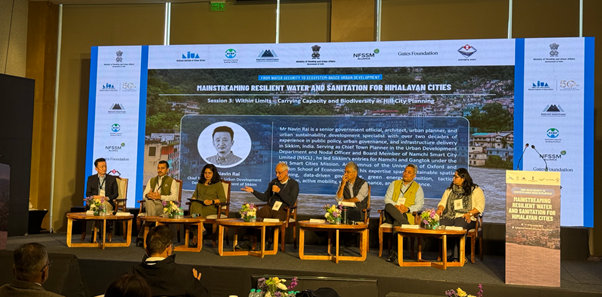
Session 3: Within Limits: Carrying Capacity and Biodiversity in Hill City Planning
The session recommended institutionalising carrying capacity assessments within statutory master plans, establishing common planning parameters across Himalayan states and integrating water availability, biodiversity conservation and ecological sensitivity into land-use planning. Discussions emphasised regional planning beyond municipal boundaries, transparent environmental monitoring, sustainable mobility and construction practices appropriate to fragile mountain environments.
Session 4: Strengthening Municipal Finance for Sustainable Service Delivery in Hilly Regions
The session recommended predictable fiscal transfers, differentiated infrastructure costing for hill cities, lifecycle financing and stronger municipal own-source revenues. Discussions highlighted tourism-linked revenue instruments, cluster-based planning, project aggregation, institutional capacity building and greater transparency in municipal budgets, accounts and audits to strengthen financial sustainability and service delivery.
Launches and Releases
The inaugural session witnessed the launch of ten initiatives, publications and learning resources focused on sustainable urban development, water and sanitation management, climate resilience, inclusive service delivery and institutional capacity building.
- Carrying Capacity Assessment of Haridwar: A Ganga Town in Uttarakhand
The report examines the implications of tourism and population pressures on urban infrastructure and services, offering recommendations for sustainable land-use planning, resource management and urban development.
- Roadmap for Transitioning Towards Integrated Citywide Sanitation for Darjeeling Municipality
The report presents a phased approach for strengthening water supply, wastewater management, solid waste management and drainage through integrated planning suited to the geographical and environmental conditions of hill towns.
- Built for All: Let's Talk GEDSI in Sanitation
An interactive comic highlighting the importance of gender equity, disability and social inclusion in the planning and delivery of safe, accessible and dignified sanitation services.
- Four Seasons, One City: A Year of Climate Change
A story illustrating the impacts of climate-related disasters on urban water and sanitation systems, highlighting practical measures for improving community preparedness and infrastructure resilience.
- Himalayan Resilience: Darjeeling – Beyond Postcard
A coffee table book documenting the water, sanitation and waste management challenges experienced in Darjeeling, alongside community initiatives and priorities for sustainable urban development.
- Occupational Health and Safety (OHS) E-course
Launched on the National Urban Learning Platform (NULP), the course provides urban officials and sanitation practitioners with practical knowledge to improve workplace safety and promote dignified working conditions for sanitation workers.
- Gender, Equity, Disability and Social Inclusion (GEDSI) E-course
Launched on NULP, the course supports urban planners, engineers and government officials in incorporating equity, accessibility and inclusion into sanitation infrastructure planning and service delivery.
- Water and Sanitation: Sustainable and Resilient Urban Futures E-course
Launched on NULP, the course provides guidance on climate risk assessment, flood and drought preparedness, and the development of resilient and inclusive urban water and sanitation systems.
- Training Manual on GIS-based Spatial Mapping for Water and Sanitation Infrastructure Integrating Kobo Toolbox
The manual provides practical guidance on geotagged field data collection, spatial analysis using QGIS and the preparation of maps to support evidence-based water and sanitation planning.
- Himalayan Urban Bio-Sheds (HUBS) Initiative for Advancing Ecosystem-based Urban Development
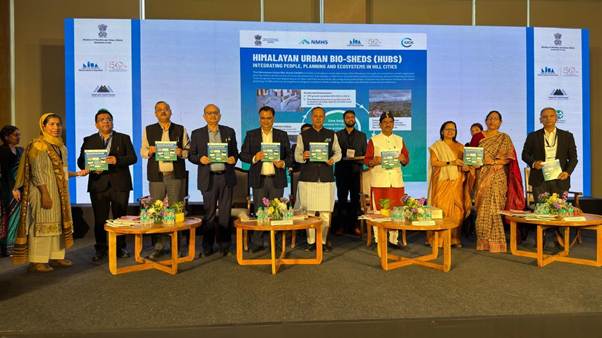
Undertaken by NIUA with support from the Ministry of Environment, Forest and Climate Change and the National Mission on Himalayan Studies (NMHS), in partnership with the International Union for Conservation of Nature (IUCN), the initiative seeks to integrate water, waste, biodiversity and ecosystem health into a unified urban planning framework. Planned for pilot implementation in three towns across Himachal Pradesh, Uttarakhand and Sikkim, HUBS aims to promote urban development approaches that respect ecological boundaries while strengthening essential urban services.
अrban Learnathon 2.0: Recognition of Innovative Urban Solutions
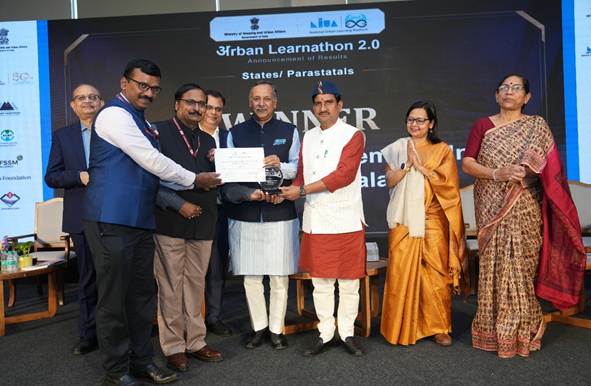
The inaugural session also marked the announcement of the results of अrban Learnathon 2.0, with the awardees felicitated by Shri Tokhan Sahu, Hon’ble Minister of State for Housing and Urban Affairs.
Launched on 08 January 2025 during the Capacity for Change Conclave 2025 by Shri Manohar Lal, Hon’ble Union Minister of Housing and Urban Affairs, अrban Learnathon 2.0 was designed to identify and recognise innovative solutions to urban challenges. The initiative received 201 entries, of which 84 were shortlisted and 18 solutions were selected for awards across categories covering government bodies, academia, industry and special mentions.
The second edition expanded participation to academia and industry, recognising the importance of collaboration among urban local bodies, research institutions and enterprises in developing innovative and replicable urban solutions. The results are available on the National Urban Learning Platform at https://nulp.niua.org/.
Delivering the closing remarks, Shri Rajiv Ranjan Mishra, Chief Advisor, NIUA, observed that institutional capacity had emerged as a common concern across the Conclave's four technical sessions. He highlighted the importance of genuine decentralisation, integrated planning, sustainable infrastructure financing and recognising the ecological sensitivity of Himalayan settlements. He emphasised that technical studies and knowledge products, including carrying capacity assessments prepared by NIUA, must inform policies, programmes and implementation practices.
Shri Vinod Kumar, Assistant Director, Urban Development Department, Government of Uttarakhand, acknowledged the contributions of NIUA and participating institutions towards strengthening regional cooperation on mountain urbanisation. Highlighting the distinct development challenges of Himalayan settlements, he called for continued collaboration among states, innovation and the adoption of technologies appropriate to mountain environments. He stated, “May the spirit of Parvat Manthan inspire us to deepen cooperation among the Himalayan states, encourage innovation and promote the adoption of appropriate technologies for mountain settlements. Our ultimate objective must be to ensure prosperity and a better quality of life for the people living in these regions.”
Dr Mahreen Matto, Team Lead, NIUA, acknowledged the long-standing partnership of the Government of Uttarakhand and the participation of representatives from 11 Himalayan states. She emphasised the importance of continued collaboration in translating the Conclave's deliberations into actionable knowledge and institutional learning. Stating that “we will ensure that the deliberations of this conclave are carried forward into our forthcoming knowledge products and reports”, she informed participants that the outcomes would be documented and shared for their suggestions and feedback.
The recommendations emerging from the two-day Parvat Manthan Conclave 2026 will inform subsequent efforts to strengthen sustainable urban development across the Indian Himalayan Region.
About Parvat Manthan
Launched by NIUA in 2023, the Parvat Manthan Hill Forum is a regional platform for dialogue, knowledge exchange and collaboration on sustainable mountain urbanisation. Building on earlier editions that addressed decentralised water and sanitation services, waste management and sustainable settlements, Parvat Manthan Conclave 2026 expanded the discussions to include disaster resilience, ecological carrying capacity, biodiversity conservation and long-term infrastructure financing, with the objective of supporting sustainable and resilient urban development in the Indian Himalayan Region.
****
SK

No comments:
Post a Comment