12 Years of Make in India
India’s Journey towards a Manufacturing Nation
A New Direction for Indian Manufacturing
Twelve years ago, on 25 September 2014, ‘Make in India’ was launched with the ambition of becoming a global hub for manufacturing, design and innovation.
The initiative focused on facilitating investment, fostering innovation and developing world-class infrastructure. Guided by ‘Minimum Government, Maximum Governance’, it has also sought to modernise processes and policies.
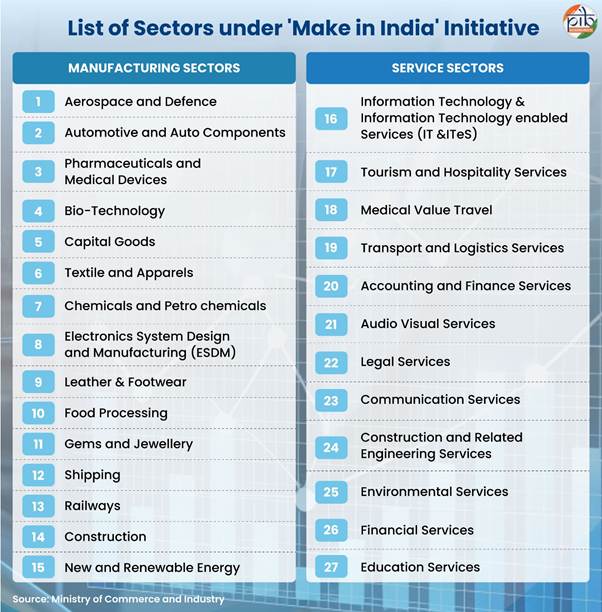
Over the years, Make in India has opened new opportunities for businesses and investors to participate in India’s manufacturing journey. The initiative has subsequently been expanded under Make in India 2.0. The initiative now focuses on 27 sectors, which include 15 in manufacturing and 12 in services.
India’s Manufacturing at a Larger Scale
Manufacturing has recorded strong growth over time. Recent indicators also point to continued growth in manufacturing.
Manufacturing Gross Value Added (GVA) at constant prices recorded a compound annual growth rate of 10.88% between 2022-23 and 2025-26 under the revised national accounts series.
Industrial output provides another indication of recent growth. The manufacturing component of the Index of Industrial Production (IIP) increased by 7.0% during April-July 2026 compared with the corresponding period of 2025.
Rising Production Across Key Manufacturing Industries
The expansion in manufacturing is also visible across several industries, with substantial increases in production and capacity.
Electronics
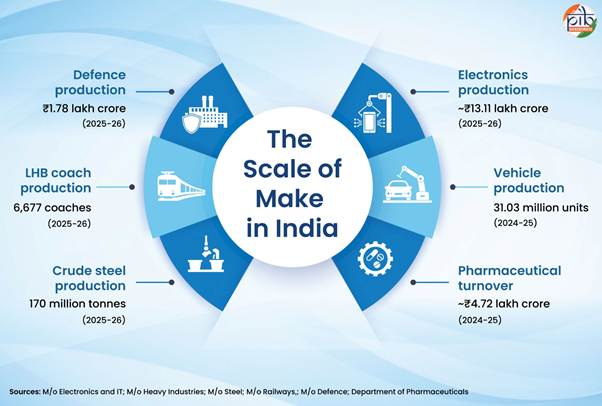
- Electronics production increased nearly sevenfold, from ~₹1.9 lakh crore in 2014-15 to ~₹13.11 lakh crore in 2025-26.
- Within this total, mobile-phone production rose approximately 33-fold, from ~₹18,000 crore to ~₹6.27 lakh crore over the same period. India is the world’s second-largest mobile phone manufacturer by volume.
- Overall electronics production also recorded 15.8% growth in 2025–26 over the previous year.
Automobiles
- Vehicle production reached 31.03 million units in 2024-25, ~33% higher than in 2014-15.
- Several vehicle segments also recorded significantly higher production in 2024-25 compared with 2020-21:
- Passenger and commercial vehicle production increased by 65% each.
- Three-wheeler production rose by 71%.
- Two-wheeler production grew by 30%.
Pharmaceuticals & Medical Devices
- India’s pharmaceutical industry ranks 3rd globally by volume and 11th by value.
- Annual turnover reached ₹4,71,898 crore in 2024-25, with a 9.5% CAGR since 2020-21.
- Domestic manufacturing of medical devices rose by ~48.2%, from ~₹28,000 crore in 2019-20 to ₹41,500 crore in 2024-25.
Steel
- Crude steel production increased from 81.7 million tonnes in 2014-15 to 170.0 million tonnes in 2025-26.
Railways
- Indian Railways manufactured 54,809 coaches over 2014-24. Average annual railway coach production rose from less than 3,300 during 2004-14 to 5,481 during 2014-24.
- Domestic production also includes locomotives and modern passenger coaches. In 2025-26, Indian Railways produced 1,674 locomotives.
- 6,677 Linke Hofmann Busch (LHB) coaches were manufactured in 2025-26. These coaches are lighter, safer and designed for greater comfort and jerk-free travel.
Defence
- The value of indigenous defence production increased from ₹46,429 crore in 2014-15 to a record ₹1.78 lakh crore in FY 2025-26. This reflected an increase of ~283%, bringing production to nearly four times its 2014-15 level.
Deepening Domestic Manufacturing Capability
The increase in final-product manufacturing is only one part of India’s manufacturing journey. Domestic capabilities increasingly extend into the inputs, components, systems and machinery used across industrial value chains.
Advanced Products and Strategic Materials
Advanced and Complex Pharmaceutical Products
- India now manufactures complex and advanced pharmaceutical products. These include Trastuzumab Emtansine, the world’s first biosimilar antibody-drug conjugate for breast cancer.
- India also manufactures Docaravimab-Miromavimab, the world’s first anti-rabies monoclonal antibody combination.
- Miqnaf is India’s first developed macrolide antibiotic in three decades for bacterial pneumonia.
- Desidustat, a new chemical entity for treating anaemia in kidney patients, further reflects India’s capability in innovative drug development.
Rare-earth permanent magnets
- A pilot plant for Nd-Fe-B (Neodymium-Iron-Boron) rare earth permanent magnets was established at the International Advanced Research Centre for Powder Metallurgy and New Materials (ARCI), Hyderabad, in March 2026. These magnets are essential for electric vehicles, renewable energy systems, electronics and advanced manufacturing technologies.
- The facility will support technology validation, process optimisation and industry collaboration. It will also help scale indigenous innovations towards commercial manufacturing while supporting deep-tech startups and private-sector participation.
Components, Systems and Assemblies
Manufacturing capabilities now increasingly cover intermediate components, integrated systems and structural assemblies used in complex final products.
Capital Goods: Machinery Behind Manufacturing
Domestic manufacturing capability also extends to the machinery used to produce, process and assemble goods. Production across heavy engineering equipment and various capital goods sub-sectors increased from ₹2,87,233 crore in 2019-20 to ₹5,69,900 crore in 2024-25. This was nearly a twofold increase over the period.
Reforms Journey under Make in India
Make in India’s reform journey combines easier investment and business processes with support for domestic production. Recent initiatives build on these measures, extending attention to components, strategic materials and specialised technologies.
Key Initiatives under Make in India
- India’s investor-friendly policy permits 100% Foreign Direct Investment (FDI) through the automatic route in most sectors, excluding certain strategic sectors. Cumulative FDI reached USD 843 billion during 2014-15 to 2025-26, rising 169% over the preceding twelve-year period.
- The National Single Window System (NSWS) helps businesses identify required approvals and apply through a common digital platform. It currently provides access to over 327 Central approvals and 3452 State approvals across 34 States and Union Territories.
- As of 21 September 2026, the platform handles an average of over 3.06 lakh applications annually. It has also onboarded over 5.69 lakh business entities, including proprietorships, companies, LLPs and foreign entities.
- India Industrial Land Bank (IILB) is a centralised GIS-enabled platform offering up-to-date spatial and non-spatial information on industrial land across India. As of May 2026, the platform mapped 4,220 industrial parks, covering ~6.98 lakh hectares.
- PM GatiShakti National Master Plan, launched in October 2021, enables infrastructure planning and coordinated execution across Central ministries/ departments and States/ UTs. It uses geospatial data, satellite imagery and API integration to support informed decisions on infrastructure development.
- Under this framework, the Network Planning Group (NPG) evaluates major Central infrastructure projects at the planning stage. It focuses on coordination, connectivity across transport modes, last-mile links and development around project locations.
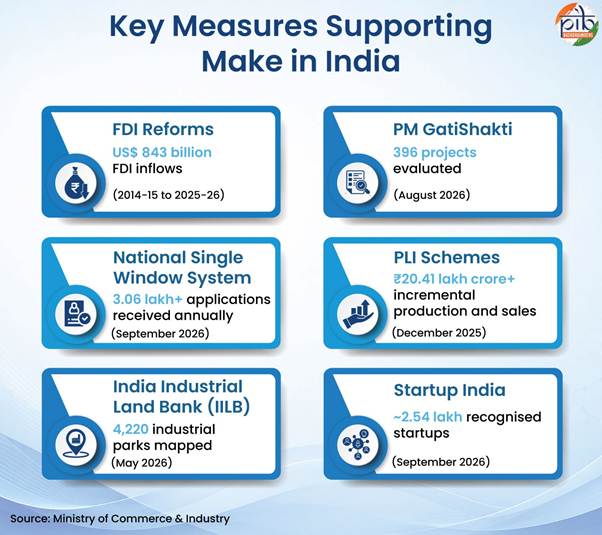
- As of 11 August 2026, NPG had evaluated 396 projects worth ~₹18.66 lakh crore. Of these, 256 projects had been sanctioned, including 198 under implementation.
- The Production Linked Incentive (PLI) schemes incentivise incremental production and sales across 14 sectors, including electronics, pharmaceuticals, automobiles, solar PV modules, specialty steel and textiles.
- As of June 2026, the schemes attracted ₹2.40 lakh crore in investment and generated over ₹22.66 lakh crore in production and sales. They also supported more than ₹15.20 lakh crore in exports and created over 14 lakh jobs.
- Launched in January 2016, Startup India aims to nurture innovation, support startups, and encourage investment in India’s startup ecosystem. As of September 2026, ~2.54 lakh entities have been recognised as startups under the initiative.
Deepening Manufacturing through Recent Initiatives
Conclusion
As ‘Make in India’ completes twelve years, it continues to strengthen India’s position as a manufacturing and investment destination.
The initiative now goes beyond producing more goods and focuses on building the skills, technology and capacity needed to make them in India. As these foundations mature, Indian manufacturing is positioned to create greater value at home and compete with confidence across global markets.
References:
Cabinet:
https://www.pib.gov.in/PressReleasePage.aspx?PRID=2288863®=48&lang=2
https://www.pib.gov.in/PressReleasePage.aspx?PRID=2284789®=48&lang=2
https://www.pib.gov.in/PressReleasePage.aspx?PRID=2284784®=48&lang=2
Ministry of Defence:
https://www.pib.gov.in/PressReleaseIframePage.aspx?PRID=2180339®=48&lang=2
Ministry of Commerce & Industry:
https://www.pib.gov.in/PressReleasePage.aspx?PRID=2246085®=48&lang=2
https://www.makeinindia.com/about
https://www.pib.gov.in/PressReleasePage.aspx?PRID=2101785®=48&lang=2
https://www.pib.gov.in/PressReleasePage.aspx?PRID=2271031®=48&lang=2
https://www.nsws.gov.in/about-us
https://www.nsws.gov.in/portal/approvalsandregistrations
https://www.pib.gov.in/PressReleasePage.aspx?PRID=2271031&lang=2®=48
https://www.pib.gov.in/PressReleasePage.aspx?PRID=2297818®=48&lang=2
https://www.pib.gov.in/PressReleasePage.aspx?PRID=2270334®=48&lang=2
https://www.startupindia.gov.in/
Ministry of Electronics & IT:
https://www.pib.gov.in/PressReleasePage.aspx?PRID=2291171&lang=2®=48
https://www.pib.gov.in/PressReleasePage.aspx?PRID=2234574&lang=2®=3
Ministry of Heavy Industries:
https://www.pib.gov.in/PressReleasePage.aspx?PRID=2224549®=48&lang=2
https://www.pib.gov.in/PressReleasePage.aspx?PRID=2199441&lang=1®=3
https://heavyindustries.gov.in/sites/default/files/2025-12/scheme_notification_0.pdf
Ministry of Steel:
https://www.pib.gov.in/PressReleasePage.aspx?PRID=2186218®=48&lang=2
Ministry of Railways:
https://www.pib.gov.in/PressReleasePage.aspx?PRID=2118452®=48&lang=2
https://www.pib.gov.in/PressReleaseIframePage.aspx?PRID=2248962&lang=2®=48
https://www.pib.gov.in/Pressreleaseshare.aspx?PRID=1753953
https://www.pib.gov.in/PressReleasePage.aspx?PRID=2282449&lang=1®=20
Ministry of Chemicals and Fertilizers:
https://pharma-dept.gov.in/sites/default/files/Annual%20Report%202025-26.pdf
Ministry of Statistics & Programme Implementation:
https://www.pib.gov.in/PressReleasePage.aspx?PRID=2298236®=48&lang=2
https://www.pib.gov.in/PressReleasePage.aspx?PRID=2304222&lang=2®=48
Ministry of Science & Technology:
https://www.pib.gov.in/PressReleasePage.aspx?PRID=2243033&lang=1®=3
Ministry of New and Renewable Energy:
https://www.pib.gov.in/PressReleasePage.aspx?PRID=2116602®=48&lang=2
https://www.pib.gov.in/PressReleasePage.aspx?PRID=2250039&lang=1®=3
https://www.pib.gov.in/PressReleasePage.aspx?PRID=2271289&lang=1®=3
Department of Atomic Energy:
https://www.nfc.gov.in/news-and-events.html
Indian Space Research Organisation (ISRO):
https://www.isro.gov.in/vikram3201.html
PIB Archives:
https://www.pib.gov.in/FactsheetDetails.aspx?Id=150923&lang=1®=20
https://www.pib.gov.in/PressReleasePage.aspx?PRID=2286949&lang=1®=48
https://www.pib.gov.in/PressNoteDetails.aspx?ModuleId=3&NoteId=158442&lang=9®=1
https://www.pib.gov.in/PressNoteDetails.aspx?ModuleId=3&NoteId=154717&lang=1®=20
https://www.pib.gov.in/PressNoteDetails.aspx?ModuleId=3&NoteId=156676&lang=2®=3
https://www.pib.gov.in/PressReleasePage.aspx?PRID=2270740&lang=1®=3
https://www.pib.gov.in/PressNoteDetails.aspx?NoteId=160099&ModuleId=3®=48&lang=1

No comments:
Post a Comment