Department of Drinking Water and Sanitation Organises 12th District Collectors’ Peyjal Samvad
Six Districts Showcase Innovative Practices on Source Sustainability, Behaviour Change through IEC activities, Grievance Redressal Mechanism and Convergence
The Department of Drinking Water & Sanitation (DDWS), Ministry of Jal Shakti, organised the 12th edition of the District Collectors’ Peyjal Samvad today through video conferencing, bringing together senior officials, District Collectors/ District Magistrates/ Deputy Commissioners, to deliberate on accelerating the implementation of Jal Jeevan Mission (JJM) 2.0 and sharing of best practices.
The Samvad was chaired by Shri Ashok K.K. Meena, Secretary, DDWS. Shri Kamal Kishore Soan, Additional Secretary & Mission Director, National Jal Jeevan Mission (NJJM) and Senior Officers from SWSM and DDWS were also present during the Samvad.
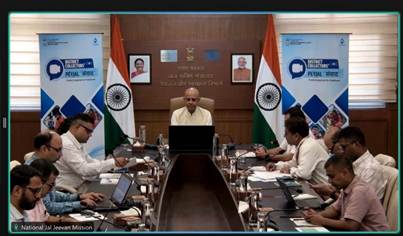
Addressing the occasion, Shri Ashok K.K. Meena, Secretary, DDWS, emphasized the importance of regular monthly District Water and Sanitation Mission (DWSM) meetings to review scheme progress, service delivery, water quality, and source sustainability under JJM 2.0. He stressed that completed schemes should be handed over to Gram Panchayats through the Jal Arpan programme after the prescribed trial run and proper documentation, thereby promoting community ownership and sustainable operation and maintenance. He urged districts to actively involve MPs, MLAs, and other public representatives through Jal Arpan ceremonies, DISHA meetings, and DWSM reviews to enhance transparency and public confidence in rural water supply systems. He also highlighted the need for timely utilization of JJM 2.0 funds, accurate reporting of physical and financial progress, and preparation of District and State Improvement Plans to address service gaps. Further, he encouraged the use of the Decision Support System (DSS) for planning source sustainability measures such as rainwater harvesting and groundwater recharge, while underscoring that regular monitoring of scheme functionality, water quality, and sustainability interventions is essential to ensure reliable and sustainable drinking water services for all rural households.
The progress and best practices of six selected districts, Shahdol (Madhya Pradesh), Samba (Jammu & Kashmir), Hooghly (West Bengal), Dhamtari (Chhattisgarh), Fatehgarh Sahib (Punjab) and North & Middle Andaman (Andaman & Nicobar Islands) were also presented by the respective District Collectors/District Magistrates/District Commissioners to facilitate cross-learning and support other districts in strengthening implementation under JJM 2.0.
Innovative Best Practices shared by six districts through presentations by the respective District Collector/ District Magistrate/ Deputy Commissioner:
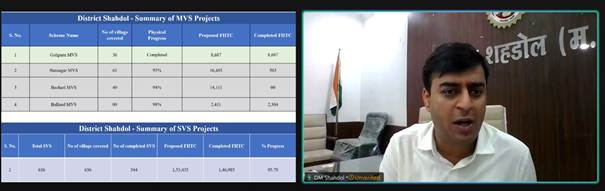
- Shahdol, Madhya Pradesh- Sh. Parth Jaiswal, District Collector informed that civil and electrical works for the water supply schemes have largely been completed, and the remaining works are expected to be commissioned by November 2026. Emphasis was laid on conducting weekly reviews to ensure timely completion of all Single Village Schemes (SVSs) and Multi Village Schemes (MVSs). Out of 544 completed SVSs, 405 have already been handed over, while 35 more are planned for handover on 2 October 2026 through the Jal Arpan programme. The district has set a target to achieve full completion and functionality of all rural water supply schemes by December 2026 and to declare the district fully functional by 26 January 2027. The district also showcased best practices, including a digital platform for overhead tank cleaning and maintenance, an online mechanism for collection of water and sanitation charges through UPI and net banking, and systems to strengthen Gram Panchayat-led operation and maintenance. These initiatives are helping improve transparency, service delivery, revenue collection, and long-term sustainability of rural drinking water infrastructure.
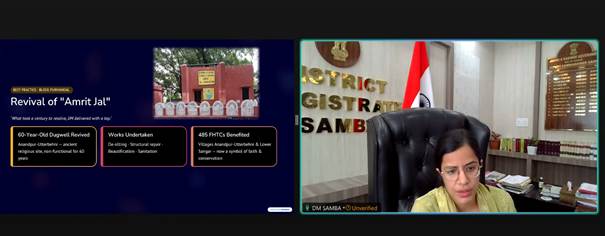
- Samba, Jammu & Kashmir- Smt Ayushi Sudan, Deputy Commissioner presented Samba as a model district under Jal Jeevan Mission, despite facing significant water management challenges due to diverse geographical conditions and dependence on groundwater sources. Through JJM, the district increased Functional Household Tap Connection (FHTC) coverage with prescribed service levels from about 23% to nearly 70%, adding around 35,000 new tap connections. The district implemented 130 water supply schemes, supported by filtration plants, tube wells, dug wells, pumping stations, and storage infrastructure. Key challenges included difficult hilly terrain, declining groundwater levels, source sustainability concerns, power supply constraints, land-related issues, and the high operation and maintenance requirements of water supply systems. To address these challenges, the district adopted location-specific solutions based on local hydrogeological conditions. Several successful interventions were highlighted, including the revival of a 60-year-old dug well at the revered Uttar Behni Temple, which now provides drinking water to hundreds of households, and the development of customized schemes for remote hilly villages through a combination of filtration plants and tube wells to ensure universal coverage.
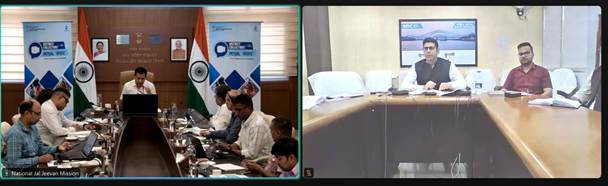
- Hooghly, West Bengal- Sh. Khursheed Ali Qadri, District Magistrate showcased the district’s substantial progress in creating drinking water infrastructure, the district shifted its focus towards community participation, service assessment, and grievance redressal to ensure sustainable service delivery under Jal Jeevan Mission. Under the Jal Seva Abhiyan, village-level service assessments were conducted by Village Water and Sanitation Committees (VWSCs), followed by validation exercises. The findings and suggested improvements were incorporated into the District Improvement Plan and submitted to the State Government. A strong emphasis was also placed on community awareness through Self-Help Groups (SHGs), with meetings, workshops, and campaigns involving nearly seven lakh women. These initiatives focused on water conservation, efficient water use, source sustainability, and reducing water wastage. To strengthen accountability, the district established a robust grievance redressal mechanism, receiving complaints through multiple channels, including helplines, emails, public representatives, and government platforms. Dedicated public hearing days are organized every week to address drinking water-related grievances promptly. Strict action has also been taken against illegal water connections and unauthorized usage to prevent water losses and ensure equitable distribution. Regular District Water and Sanitation Committee (DWSC) and DISHA meetings are being conducted with active participation of public representatives to review JJM implementation, address concerns, and undertake corrective measures. These efforts have significantly improved community engagement, transparency, service delivery, and public confidence in rural drinking water systems.
- Dhamtari, Chhattisgarh- Sh. Abhinash Mishra, District Collector showcased that the district reported significant progress in the implementation of MVSs, with the majority of schemes already completed and the remaining works expected to be completed after obtaining necessary clearances, particularly in forest and tiger reserve areas. To ensure effective operation and maintenance (O&M), regular DWSM meetings are being conducted twice a month, focusing on scheme sustainability, convergence activities, payment issues, and service delivery improvements. The district has strengthened community ownership by ensuring active participation of VWSCs, with user charges being collected online based on population served. Gram Panchayats have been entrusted with the day-to-day O&M of water supply assets. Special emphasis has been placed on awareness generation through SHGs and community mobilization, with women playing a leading role in water governance. More than two-thirds of the Sarpanches and community representatives involved in these initiatives are women. A notable success story highlighted was a solar-powered Single Village Scheme in a remote tribal habitation, which has significantly improved access to drinking water in difficult terrain. The initiative received wide public appreciation and demonstrated how community participation, renewable energy, and decentralized management can contribute to sustainable rural drinking water service delivery.
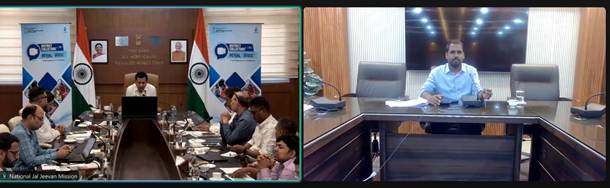
- Fatehgarh Sahib, Punjab- Dr. Sona Thind, Deputy Commissioner highlighted the district’s successful achievement of 100% FHTC coverage, ensuring tap water supply to all 78,475 rural households across 429 villages, along with full coverage of schools and Anganwadi centres. Building upon this achievement, the district has shifted its focus towards maintaining service quality, with nearly 80% of rural households receiving more than 70 lpcd of water, exceeding the JJM benchmark of 55 lpcd. To address groundwater depletion and water quality concerns, the district implemented a major 12 MLD surface water project drawing water from the Rajpura Distributary. The project serves 92 villages and has significantly benefited fluoride-affected areas by providing safe drinking water to over 86,000 people through an extensive pipeline network. The district has also adopted IoT-based real-time monitoring systems and a dedicated grievance redressal mechanism to ensure continuous service delivery and prompt response to complaints. Regular DWSM meetings, community participation through Gram Panchayats and VWSCs, and structured planning have strengthened local ownership of water supply systems. A strong emphasis has been placed on water quality surveillance, with NABL-accredited laboratories conducting regular testing and women-led community monitoring through Field Testing Kits (FTKs). Through a combination of surface water infrastructure, digital monitoring, community participation, and rigorous quality testing, the district has developed a sustainable model for maintaining safe and reliable drinking water services under Jal Jeevan Mission.
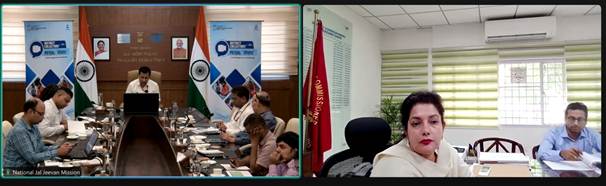
- North and Middle Andaman, Andaman & Nicobar Islands- Sh. Sushant Padha, Deputy Commissioner highlighted the district's achievement of 100% FHTC coverage, covering all villages and approximately 24,400 households under Jal Jeevan Mission. A total of eight JJM schemes were completed with an expenditure of about ₹5.2 crore, ensuring universal rural water supply coverage. Given the district's unique island geography and recurring summer water scarcity, monthly DWSM meetings are being conducted to review water availability and plan long-term sustainability measures. Discussions focus on rejuvenation of existing water sources, construction of ponds, ring wells, and water treatment plants, as well as expediting Environmental Impact Assessment (EIA) clearances, which often delay project implementation due to the district's extensive forest cover. To address seasonal water shortages, the district has adopted a decentralized approach by creating village-level water storage structures and enhancing local water security through convergence with MGNREGA and other development programmes. The administration is also working closely with ISRO's National Remote Sensing Centre (NRSC) to identify and study spring sources, assess groundwater feasibility, and improve recharge measures. The district has placed strong emphasis on water quality monitoring, with regular sample testing through WQMIS-enabled laboratories and continuous surveillance of drinking water sources. A proactive grievance redressal mechanism, supported by digital communication platforms and local stakeholder networks, helps ensure prompt resolution of complaints, including a focus on zero-leakage service delivery. Awareness campaigns on water conservation, social water audits, community training, and public outreach through print and social media are being conducted extensively to promote responsible water use and strengthen long-term source sustainability in the island district.
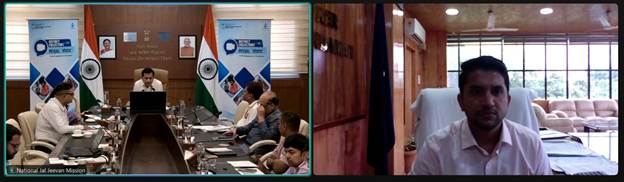
In his concluding remarks, Shri Kamal Kishore Soan, AS&MD, NJJM appreciated the presentations made by Districts and urged that all Mission Directors to actively participate in the upcoming Skilling and Nal Jal Mitra Programme discussions by coordinating with the State Skill Development Departments and sharing inputs before the virtual meeting scheduled on 21 September 2026. Further, he stated that States/UTs were also advised to commence geo-tagging of rural water supply sources from 2 October 2026. Further, Jal Arpan activities should be organized on 2 October 2026 across the maximum possible number of Gram Panchayats, with details of participating GPs to be shared with the Department by 20 September 2026. States/UTs were also directed to initiate post-monsoon testing of water supply sources from 2 October 2026. The meeting concluded with appreciation for the efforts of all participating States and Districts towards effective implementation of the Jal Jeevan Mission 2.0.

No comments:
Post a Comment