From Waste Picker to Swachhta Udyami: Balamala Malli's Journey Towards Dignity and Self-Reliance
The limited income, social exclusion and lack of educational opportunities can restrict the possibility of building a secure future for sanitation workers from economically disadvantaged communities. Timely financial assistance and access to mechanised sanitation equipment can help transform such vulnerable livelihoods into safer and more sustainable sources of income.
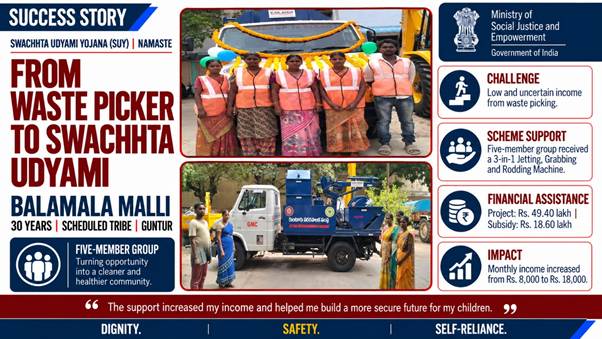
Demonstrating the impact of support under the Swachhta Udyami Yojana (SUY) component of the NAMASTE Scheme, Shri Balamala Malli, a 30-year-old member of the Scheduled Tribe community, has moved towards greater economic stability and dignity. As part of a five-member group project, he received assistance to procure a 3-in-1 Jetting, Grabbing and Rodding Machine, which created an additional livelihood opportunity for him and the other group members.
Shri Malli has worked as a waste picker with the Guntur Municipal Corporation in Andhra Pradesh, for the past ten years. He worked six days a week and earned approximately Rs. 150 to Rs. 200 per day.
Poverty had prevented Mr. Malli from attending school. His parents were extremely poor, and he began accompanying them in waste-picking activities at a young age instead of receiving a formal education. As an illiterate member of the Scheduled Tribe community living in an urban slum, he also faced social discrimination, exclusion and limited access to essential amenities and services.
His wife is a homemaker, and the couple have three children studying in elementary school. Despite the family's difficult socioeconomic circumstances, Mr. Malli aspired to become economically self-sufficient and provide his children with quality education and a better future.
On 19 June 2023, financial assistance was provided by the National Safai Karamcharis Finance and Development Corporation (NSKFDC) under SUY for a group project comprising Shri Malli and four other members. The support enabled the group to procure a 3-in-1 Jetting, Grabbing and Rodding Machine for mechanised sanitation work.
The project had a total cost of Rs. 49,40,710. It was supported through a loan amount of Rs. 30,80,530 and an upfront capital subsidy of Rs. 18,60,180. Access to the machine enhanced the group's livelihood opportunities and enabled its members to undertake sanitation operations through safer and more efficient mechanical methods.
Before receiving assistance, Shri Malli earned approximately Rs. 8,000 per month through waste-picking activities. Following the procurement of the 3-in-1 machine, he began earning an additional Rs. 10,000 per month, increasing his total monthly income to approximately Rs. 18,000.
The increase in income has enabled Shri Malli to meet household expenses more comfortably, support his children's education and address several of the economic challenges that previously affected his family. The intervention has strengthened his livelihood and helped him lead a more stable and dignified life.
Shri Malli's journey shows how financial assistance, collective enterprise and mechanised sanitation equipment can improve livelihood security for sanitation workers. From relying on low-paid waste-picking work, he has become part of a group enterprise with improved earning opportunities and greater confidence about his family's future.
Talking about the support, Shri Malli said, “The support helped me increase my income and provide better education and a more secure future for my children. I now feel more confident about supporting my family and living with dignity.”
Today, he is working towards economic self-reliance and ensuring that his children receive the education and opportunities that poverty denied him. His progress reflects the role of the SUY component of the NAMASTE Scheme in advancing safety, dignity and sustainable livelihoods among sanitation workers.

No comments:
Post a Comment