BRICS
Evolution, Cooperation and India's Leadership
A boardroom acronym for four emerging markets has grown into something far bigger. Today It is a geopolitical bloc spanning four continents. The journey runs from a four-country dialogue to today's far wider grouping. Successive waves of membership pulled in oil states, African economies and Southeast Asian partners. At the centre of this expanding architecture sits India this year, chairing the grouping for a fourth time since its inception.
BRICS: Shaping an Inclusive Global Order
BRICS has emerged as a key platform for coordinating economic policy among major emerging economies. It serves as the principal forum where these nations shape a common position on global governance. Through sustained dialogue, it has become a channel for advancing the interests of the Global South within multilateral institutions. Its agenda spans development, finance, technology, trade and people-to-people exchanges. The grouping reflects the growing economic weight and aspirations of emerging economies globally. It provides members with a platform to share experiences and address common challenges.
Under its 2026 Presidency, India is set to host the 18th BRICS Summit in New Delhi on 12–13 September 2026. It will mark India’s fourth Chairship of BRICS in 2026. India’s Chairship is guided by the theme “Building for Resilience, Innovation, Cooperation and Sustainability.” The theme reflects India’s focus on strengthening existing achievements and institutional effectiveness. It places development, sustainability and innovation at the heart of the agenda. It also highlights the aspirations of the Global South. India seeks to reinforce BRICS as a constructive and solutions-oriented forum.
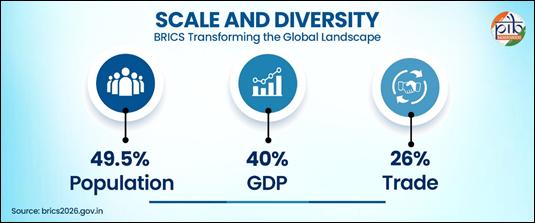
Today, BRICS comprises 11 countries: Brazil, China, Egypt, Ethiopia, India, Indonesia, Iran, Russia, Saudi Arabia, South Africa and the UAE. Collectively, these members represent 49.5% of the global population, 40% of global GDP, and 26% of global trade. These figures underline their substantial demographic and economic weight. Its expanded membership has also widened its geographical reach across Asia, Africa, the Middle East and Latin America. This diversity brings together major markets, natural resources, technological capabilities and varied development experiences.
The Aim, Objective and Areas of Cooperation
BRICS was initially conceived as a forum for dialogue on major issues shaping the international agenda. Its early focus was on developing common positions on global political and economic matters. It sought to promote a more democratic, legitimate and balanced international order. The grouping also emphasised sustainable economic and social development, social inclusion and shared prosperity among emerging economies. Over time, these priorities have provided a foundation for deeper and broader engagement among members.
Across successive summits, BRICS cooperation has progressively expanded to encompass strategic global issues and areas of practical collaboration. Its agenda covers terrorism, climate change, food and energy security, trade and agriculture. It also addresses labour and employment, telecommunications, international finance and the global economic situation. BRICS advocates for greater representation and equity in international institutions, including the WTO and global financial architecture. These efforts seek to make global governance more inclusive, effective and responsive to contemporary challenges.
BRICS Through the Years: From Crisis to Collective Action
The 2008 global financial crisis marked a defining moment in the evolution of BRICS. It exposed gaps in the existing global financial architecture. It also created a need for broader consensus on global economic governance. The four BRIC countries articulated a common position on these issues. They called for a more representative international financial system. They sought greater voice for emerging economies in the International Monetary Fund (IMF) and World Bank. They also opposed protectionism and supported an open, rules-based multilateral trading system. This coordination laid the foundation for the first BRIC Summit in Yekaterinburg, Russia, in 2009.
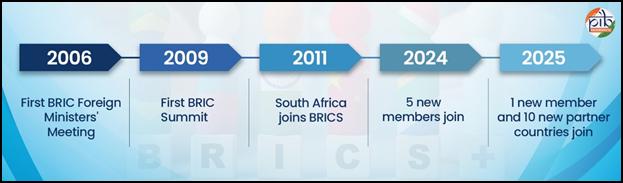
BRIC was formally established in 2006 as a political cooperation forum among Brazil, Russia, India and China. Its founding members shared an aspiration for a more representative and equitable global order. South Africa joined as a full member in 2011, transforming BRIC into BRICS. This inclusion expanded the grouping’s geographical representation across continents. The grouping subsequently broadened its agenda beyond economic issues to development, finance, health, climate action, technology and trade. This evolution strengthened BRICS as a wider framework for engagement among emerging economies.
A Wider BRICS: Expanding Reach, Deepening Engagement
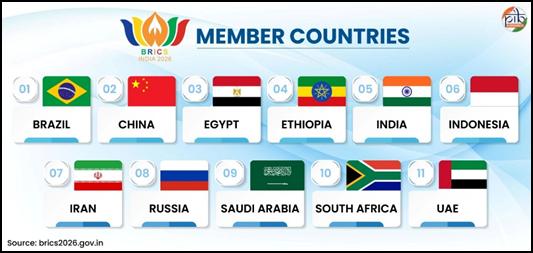
A major phase of expansion began in January 2024. Egypt, Ethiopia, Iran, Saudi Arabia and the UAE became full members. Indonesia joined as the eleventh full member in January 2025. These accessions significantly expanded BRICS’ geographical and economic reach. The expansion was accompanied by the creation of a Partner Country category. Ten countries joined this framework during 2025: Belarus, Bolivia, Cuba, Kazakhstan, Malaysia, Nigeria, Thailand, Uganda, Uzbekistan and Vietnam. The new arrangement provides an additional channel for structured engagement with BRICS.
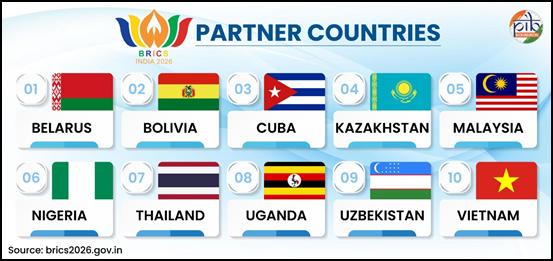
The Partner Country framework broadens BRICS’ outreach without altering its full-membership structure. It strengthens opportunities for South-South cooperation across Asia, Africa, Latin America and Eurasia. The wider network also creates scope for collaboration on trade, finance, climate action and sustainable development. It reflects growing interest among emerging economies in participating in discussions on global governance.
The evolution of BRICS demonstrates a shift from a four-country economic dialogue to a broader framework for political, economic, financial and social cooperation. Its expansion has increased its demographic and economic weight. It has also broadened its regional representation and areas of engagement. The grouping’s institutional evolution has kept pace with the changing priorities of emerging economies.
India at the Helm of BRICS: From Continuity to Consensus
Before this year, India has previously chaired BRICS in 2012, 2016 and 2021. Each Chairship reflected the priorities and challenges of its respective period. India’s repeated leadership demonstrates its sustained engagement with the grouping. It also reflects India’s commitment to constructive multilateralism and the priorities of developing economies.
2012: Laying the Foundation for Stronger Cooperation
India hosted the Fourth BRICS Summit in New Delhi on 29 March 2012. The Summit was held under the theme “BRICS Partnership for Global Stability, Security and Prosperity.” Discussions focused on global governance reform, sustainable development, food security and energy security. The Summit adopted the Delhi Declaration and an Action Plan for strengthening BRICS cooperation. The outcomes established a stronger foundation for institutional and sectoral engagement. Click to Read More About the Delhi Declaration
2016: Goa Summit Expanded BRICS Outreach
India hosted the Eighth BRICS Summit in Goa in October 2016. The Summit was held under the theme “Building Responsive, Inclusive and Collective Solutions.” India’s Chairship focused on strengthening intra-BRICS cooperation and expanding outreach. It also advanced collaboration on counter-terrorism, trade, innovation and multilateral coordination. The Goa Summit reinforced the grouping’s focus on emerging global challenges and practical cooperation.
2021: Consolidating Cooperation in a Changing World
India hosted the 13th BRICS Summit virtually on 9 September 2021. The Summit marked the 15th anniversary of BRICS. It was held under the theme “BRICS@15: Intra-BRICS Cooperation for Continuity, Consolidation and Consensus.” India focused on strengthening institutional continuity, deepening cooperation and building greater consensus. The Chairship also advanced cooperation across health, digital technologies, counter-terrorism and sustainable development.
Through successive Chairships, India has contributed to the institutional and substantive development of BRICS. Its priorities have evolved with emerging global challenges while retaining a focus on practical cooperation. India’s 2026 Chairship builds on this experience and the grouping’s expanded membership.
BRICS 2026: Key Outcomes Emerging from Ministerial Meetings
India assumed its fourth BRICS Chairship on 1 January 2026. During its Chairship, India convened a series of ministerial meetings across priority areas of BRICS cooperation. Over the year, BRICS members countries exchanged views on shared priorities and global and regional developments. These discussions advanced cooperation across the grouping’s three fundamental pillars. The pillars comprise political and security cooperation, economic and financial cooperation, and cultural and people-to-people exchanges.
More than 350 meetings and high-level engagements were held across 25 cities during India’s Chairship. The meetings generated practical and development-oriented outcomes across key areas of cooperation. The following outcomes emerged from ministerial meetings held during India’s 2026 BRICS Chairship.
- BRICS Centres of Excellence on Agro-Ecology agreed upon as a collaborative platform for joint research, knowledge sharing and capacity building on natural, organic and regenerative farming practices to promote climate-resilient and sustainable agricultural systems (initially coordinated by ICAR-Indian Institute of Farming Systems Research, Modipuram). BRICS Network on Digital Agriculture to deepen cooperation and scale the deployment of AI‑driven decision‑support systems, geospatial intelligence, IoT‑enabled monitoring, and advanced data analytics in agriculture (initially coordinated by IIT Delhi).
- BRICS AGRIN (Agro-Inputs, Genetic Resources and Information Network) agreed upon as a voluntary, farmer-centric cooperation framework among BRICS countries to strengthen collaboration in seeds, germplasm, and agricultural inputs.
- BRICS Mission for Healthy Lifestyle: The priority was launched along with the BRICS Roadmap for a Joint Initiative on Healthy Lifestyle Promotion (2026-2029). It aims to serve as a collaborative platform for technical cooperation, knowledge exchange and coordinated awareness initiatives, promoting preventive and life-course approaches to obesity and other non-communicable diseases.
- BRICS Expert Working Group on Traditional, Complementary and Integrative Medicine (TCIM): It aims to serve as a platform for structured and consensus-based cooperation on TCIM, covering policy dialogue, research and evidence generation, capacity building and academic exchange, digital knowledge platforms, quality and regulatory standards, and the protection of traditional and indigenous knowledge.
- Focus on Mental Health through BRICS Training Hub Network and BRICS Network of Centres of Excellence, with NIMHANS India as the coordinating Centre. It aims to optimize human resources for mental health through upskilling, task-sharing and standardized training, and to integrate mental well-being into primary healthcare.
- Mainstreaming Traditional Knowledge through adoption of BRICS Principles for Advancing Climate Resilience through People-centric and Community-based Adaptation and BRICS Guiding Principles on Strengthening Academic Collaboration on Traditional and Indigenous Knowledge Systems.
- Advancing Sustainable Lifestyles through Network of BRICS Institutions to Advance Knowledge Sharing, Research & Innovation and Sustainable Lifestyles Week for exchange of knowledge on policies, programmes, initiatives and leading practices; conduct capacity-building workshops on thematic areas; facilitate dialogue among stakeholders including academic and research institutions; and compilation of case studies.
- BRICS CONNECT for Skilling: A BRICS Cooperation Network for Capacity Building, Employability, and New Skills and Technologies (BRICS CONNECT), building on the BRICS Virtual Liaison Office. It is a flexible platform with four components, namely capacity building for advancing social security, women’s participation in the workforce, skills and employability, and digital public infrastructure. Cooperation under it is voluntary and non-binding.
- Smart Grids and Energy Storage: The BRICS Guiding Principles on Energy Storage and Smart Grids were adopted and the BRICS Digital Centre of Excellence for Smart Grids and Energy Storage was launched to serve as a voluntary platform for knowledge sharing, capacity building, the exchange of policy and regulatory best practices, and promotion of pilot initiatives among BRICS countries.
- Urban Infrastructure strengthened through establishment of BRICS Urban Mobility Hub, a virtual collaborative platform which will promote knowledge sharing, capacity building and technical cooperation in sustainable urban mobility; adoption of BRICS Voluntary Principles for Climate Resilient Urban Infrastructure to support the integration of climate and disaster risk considerations into urban planning, design, investment, construction, and maintenance; and establishment of a BRICS Urban Research and Knowledge Network for applied urban research, cross-border peer learning, and sustained institutional collaboration.
- BRICS MSME Cooperation Portal, to serve as a digital ecosystem accessible to all BRICS member countries, supporting MSMEs, technology centers and clusters, trade associations, financial institutions, training and capacity-building institutions, policymakers, and other relevant stakeholders, along with an institutionalized Dialogue on MSME Finance and Workplan on the Internationalisation of MSMEs were key outcomes to leverage BRICS for enhancing MSMEs’ access to markets and finance.
- BRICS Incubator Network, a digital interface/network to connect National Nodal Agencies, selected incubators and start-ups across BRICS countries, facilitate registration and linkages with participating incubators, and enable referral of qualified start-ups to incubators in other BRICS countries.
- BRICS Startup Innovation Fund to catalyse financing for early and growth stage startups and foster innovation driven entrepreneurship in BRICS countries.
- BRICS Science and Research Repository welcomed as a structured platform for scientific knowledge storage and sharing among BRICS countries.
- BRICS Logistics Supply-Chain Cooperation Framework: A voluntary, consensus-based framework to strengthen cross-sector transport logistics resilience and sustainability. It aims to address fragmented supply chains and weak connectivity by promoting technical exchange, knowledge sharing on cargo and shipping services, localized assembly and manufacturing ecosystems, and capacity building, while advancing environmentally sustainable and climate-resilient logistics practices.
- BRICS Cooperation on Global Value Chains through GVC Action Plan 2026-2030, including a Technical Council and GVC Joint Study for enhanced BRICS cooperation to ensure that GVCs are resilient, efficient and productive; and to advance the opening of markets and economic diversification among BRICS Members.
- BRICS Agreement on Cooperation and Mutual Administrative Assistance in Customs Matters: Members confirmed their in-principle approval and willingness to sign the Agreement to support faster trade, lower transaction costs, more secure borders, trusted trade facilitation, improved ease of doing business, and tackling illicit trade.
- Cooperation in the Field of Standardization through an MoU signed by BRICS National Standards Body Heads, a formal framework to strengthen collaboration in the development, adoption and implementation of standards, promote information sharing, exchange of best practices, technical cooperation and capacity building, reinforce quality infrastructure, enhance consumer protection, reduce technical barriers to trade.
- BRICS Youth Cooperation Framework 2026 adopted as a reference document to support continuity, coherence and structured cooperation to guide future dialogue, experience sharing and the consideration of practical initiatives under the BRICS Youth Track.
- Sport Technology Cooperation institutionalized through a new Working Group to promote cooperation in the field of sport technology in the form of exchange of good practices, institutional experiences, technical information and research inputs.
The ministerial meeting outcomes under India’s 2026 BRICS Chairship reflect a continued focus on practical cooperation, inclusive growth and a stronger voice for the Global South.
2026: Steering BRICS Towards a More Inclusive Future
India’s 2026 BRICS Chairship comes at a time of significant global transformation. The international system is experiencing economic fragmentation, technological disruption and geopolitical uncertainty. Climate change and resource pressures are adding further complexity. These interconnected challenges require cooperation that is inclusive, practical and responsive to diverse national circumstances.
BRICS provides an important avenue for addressing these challenges through dialogue and coordinated action. Its expanded membership brings diverse perspectives from major emerging economies. The grouping can help advance cooperation on development, climate action, technology, energy and financial resilience. It can also contribute to discussions on reforms in global institutions.
For India, the objective extends beyond expanding the grouping’s scale. It is about converting greater representation into meaningful cooperation and tangible outcomes. India’s Chairship seeks to build consensus across diverse members while strengthening the effectiveness of existing mechanisms. India aims to reinforce BRICS as a constructive force for a more inclusive global order.

No comments:
Post a Comment