
Ramsar Sites in India
Safeguarding Wetlands of International Importance
Ramsar Sites in India — At a Glance
As per the Ramsar Convention, "Wetlands are the areas of marsh, fen, peatland or water, whether natural or artificial, permanent or temporary, with water that is static or flowing, fresh, brackish or salt, including areas of marine water the depth of which at low tide does not exceed six metres”. Linking land and water, wetlands store fresh water, recharge groundwater, buffer floods and sustain fisheries and farming. They also shelter migratory birds and rich biodiversity, placing them among the most productive ecosystems on Earth.
Globally, these habitats are protected under the Convention on Wetlands or the Ramsar Convention, an intergovernmental treaty. It was adopted at Ramsar, Iran, on 2 February 1971 and entered into force in 1975. As on October 2026, it now includes 172 Contracting Parties and over 2,536 designated "Ramsar Sites" worldwide.
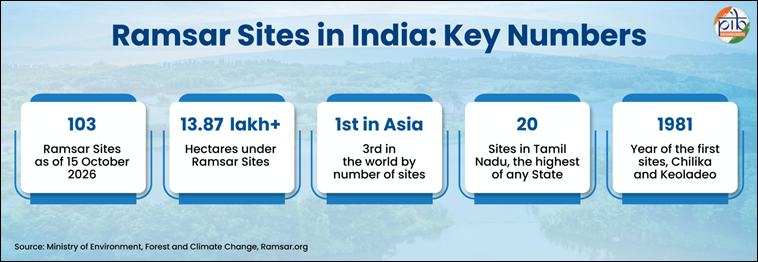
India, home to a large number of wetlands, became a Party to the Convention on 1 February 1982. It has steadily expanded its network since then. The country now has 103 Ramsar Sites, a nearly fourfold rise from just 26 sites in 2014. India’s network ranks first in Asia and third in the world in terms of number of sites. Collectively, these sites cover more than 13.87 lakh hectares across 28 States and Union Territories.
Understanding Ramsar Sites
A Ramsar Site is a wetland designated as a Wetland of International Importance under the Ramsar Convention. These sites are recognised for their ecological, botanical, zoological, limnological or hydrological significance. The Ramsar Convention rests on three pillars. These are the wise use of all wetlands, the designation and effective management of Ramsar Sites, and international cooperation on wetland conservation.
How a Wetland is Designated
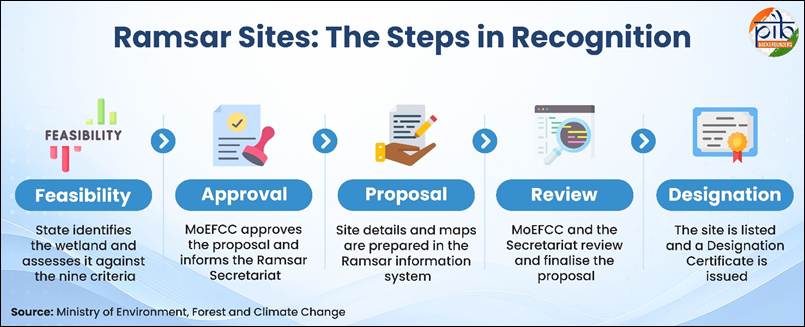
In India, the process begins with the State Government or Union Territory Administration identifying a suitable wetland. The Ministry of Environment, Forest and Climate Change then coordinates approval and forwards the proposal to the Ramsar Secretariat.
Criteria for Designation
A wetland must meet at least one of nine criteria to qualify as a Wetland of International Importance. The criteria fall into two groups, covering wetland types and the conservation of biological diversity.
Benefits of Designating Wetlands to Ramsar List
Designating wetlands to the Ramsar list and meeting Ramsar Convention commitments is a contribution to global efforts for biodiversity conservation. Ramsar Sites are recognized as being of significant value not only for a country but for humanity as a whole. Designating Ramsar Sites and ensuring their conservation and wise use:
- Provides a platform for international representation: Enables countries to voice their concerns at the principal intergovernmental forum on wetland conservation and wise use. At the Ramsar 15th Conference of Parties held at Victoria Falls, Zimbabwe, India introduced a Resolution on ‘Promoting Sustainable Lifestyles for the Wise Use of Wetlands’. The resolution was adopted at the Conference. The resolution received overwhelming support from the 172 Ramsar Contracting Parties, Six International Organisation Partners, and other observers.
- Enhances visibility and recognition: Increases the international visibility and recognition of Ramsar Sites. This can strengthen support for their conservation and wise use.
- Provides access to international standards and guidance: Offers access to the latest information on internationally accepted standards for identifying wetlands of international importance. It also provides guidance on wise use and wetland management planning.
- Facilitates expert assistance: Enables access to expert advice on national and site-specific wetland conservation and management challenges. Support is available through the Ramsar Secretariat, its collaborators, and Ramsar Advisory Missions, where appropriate.
- Promotes international cooperation and financial support: Encourages cooperation on wetland conservation and management. It can also facilitate project support through the Convention’s small-grant programmes and links with multilateral and bilateral funding agencies.
Commitments After Designation
Designation commits the State or Union Territory to the wise use of the wetland and its resources. The site is deemed notified under the Wetlands (Conservation and Management) Rules, 2017, and also the guidelines recommend to be formally notified under these rules with an Integrated Management Plan. The Ramsar Information Sheet must be updated every six years, and the site’s ecological character monitored regularly. Guided by these criteria and commitments, India has built a large and remarkably diverse network of Ramsar Sites.
India’s Ramsar Sites — From 26 to 103
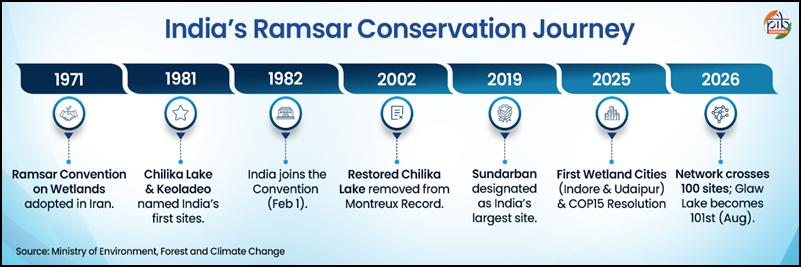
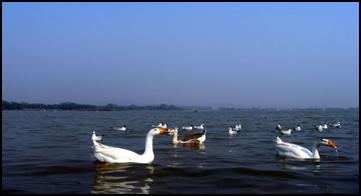
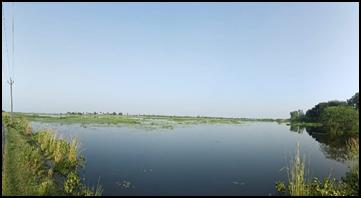
India’s Ramsar Sites span high-altitude lakes, river floodplains, mangroves, coral reefs, village tanks and urban marshes. Tamil Nadu has the highest number with 20 sites, followed by Uttar Pradesh with 14 sites. Growth has been rapid, and in 2025 alone, 11 wetlands were added, taking the national total to 96. Surha Tal in Uttar Pradesh became the 100th site in June 2026, and Glaw Lake the 101st in August. India’s Ramsar site tally has reached 103 on October 15, 2026, with the designation of Sukhna Wetland in Chandigarh and Sauj Jheel in Uttar Pradesh as the latest additions to the list.
State-wise List of Ramsar Sites
The table below lists all 103 Ramsar Sites by State and Union Territory, with their key conservation value.
How Ramsar Sites Aid in Conservation
Ramsar status brings global recognition, scientific guidance and access to expert advice for designated wetlands. It also places clear duties on States to protect each site’s ecological character through planning and monitoring.
- Restoring Ecosystems: Chilika Lake shows how sustained restoration can revive a wetland and the communities that depend on it. Today, the lagoon supports 118 fish species and serves as a breeding, wintering and staging ground for waterbirds.
- Sustaining Livelihoods: The East Kolkata Wetlands treat the city’s wastewater naturally through about 4,000 hectares of fish ponds. They yield about 10,500 tonnes of fish a year and directly support about 50,000 people.
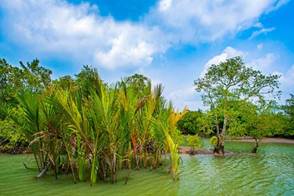
- Building Climate Resilience: The Sundarban mangroves shield inland areas from storms, cyclones, tidal surges and saltwater intrusion. They also serve as nurseries for fish and shellfish, sustaining fisheries along India’s entire eastern coast.
- Reviving Threatened Species: The Beas Conservation Reserve in Punjab holds India's only known population of the endangered Indus River dolphin. A reintroduction programme launched in 2017 released 47 gharials, nearly three decades after they vanished from the river. The 185-kilometre river stretch also supports more than 500 bird species and over 90 fish species.
- Community Stewardship: Khichan Wetland in Rajasthan hosts more than 22,000 wintering demoiselle cranes each year on just 54 hectares. Residents of the adjoining village actively protect the birds from power line collisions and stray dog attacks.
Government Initiatives for Wetland Conservation
India’s Ramsar network is backed by a strong framework of laws, schemes and people’s participation.
Wetlands (Conservation and Management) Rules, 2017
Notified under the Environment (Protection) Act, 1986, these Rules provide the regulatory framework for wetland conservation. They establish State/UT Wetlands Authorities and prohibit activities such as encroachment, waste dumping and untreated effluent discharge.
National Plan for Conservation of Aquatic Ecosystems (NPCA)
NPCA merged the national programmes for lake and wetland conservation into one scheme. Updated NPCA Guidelines issued in 2024 give States an integrated and scientific framework for managing wetlands.
Amrit Dharohar
Amrit Dharohar promotes the unique conservation values of India’s Ramsar Sites. It covers species and habitat conservation, nature tourism, wetland livelihoods and wetland carbon assessment. Under this, studies for the inventory of flora and fauna of 75 Ramsar Sites have been conducted by the Botanical Survey of India and the Zoological Survey of India, respectively. A ‘Standard Operating Procedure for Assessment of Carbon Stock in Wetlands’ was released, and has been utilised to assess the Carbon stock of 39 Ramsar Sites across the country.
Mission Sahbhagita and the Save Wetlands Campaign
Mission Sahbhagita promotes participatory conservation; its Save Wetlands Campaign began in Goa on 4 February 2023. Over 2 million citizen volunteers have since helped map more than 1.7 lakh wetlands across the country.
Mangrove Initiative for Shoreline Habitats and Tangible Incomes (MISHTI)
MISHTI targets mangrove restoration over 540 square kilometres in nine States and four UTs. So far, ₹88.44 crore has been released to restore 9,949.5 hectares of degraded mangroves.
Wetlands of India Portal
Inaugurated on 2 October 2021, the portal serves as a dynamic knowledge repository on India’s wetlands. It offers single-point access to information on sites, projects, initiatives and training for managers and citizens.
Wetland City Accreditation
Indore and Udaipur became India’s first Ramsar-accredited Wetland Cities in January 2025, joining the global network of Ramsar-accredited Wetland Cities.
Way Forward
India’s expanding Ramsar network offers an opportunity to strengthen wetland conservation through science, effective management and community participation. The focus ahead must be on translating international recognition into lasting ecological outcomes. Regular monitoring, evidence-based planning and coordination among governments, institutions and local communities can help maintain the ecological character of these wetlands. Sustained efforts will be essential to ensure that wetlands continue to support biodiversity, water security, climate resilience and livelihoods for future generations.
Equally important is the need to integrate wetland conservation into wider development planning. Strengthening local stewardship, improving data and knowledge sharing, and promoting sustainable livelihood opportunities can deepen conservation efforts. By combining ecological priorities with the needs of communities, India can build a more inclusive and resilient approach to wetland management, ensuring these ecosystems remain productive and protected over the long term.
References
Ministry of Environment, Forest and Climate Change (MoEFCC)
- https://moef.gov.in/ramsar-convention
- https://indianwetlands.in/wp-content/uploads/library/1761126102.pdf
- https://moef.gov.in/uploads/2019/09/Identifying-and-Managing-Wetlands-of-International-Importance_-Brochure.pdf
- https://moef.gov.in/wetlands-of-india-portal
- https://www.pib.gov.in/PressReleaseDetail.aspx?PRID=2324120®=48&lang=1
- https://www.pib.gov.in/PressReleasePage.aspx?PRID=2294036
- https://www.pib.gov.in/PressReleasePage.aspx?PRID=2269189
- https://www.pib.gov.in/PressReleasePage.aspx?PRID=2210100
- https://www.pib.gov.in/PressReleasePage.aspx?PRID=2150496®=48&lang=2
- https://www.pib.gov.in/PressReleasePage.aspx?PRID=2096165
- https://www.pib.gov.in/PressReleseDetailm.aspx?PRID=1913469®=3&lang=2
- https://www.pib.gov.in/Pressreleaseshare.aspx?PRID=1896301
- https://static.pib.gov.in/WriteReadData/specificdocs/documents/2025/apr/doc202541530201.pdf
- https://www.pib.gov.in/PressReleasePage.aspx?PRID=2221114
- https://www.pib.gov.in/PressReleasePage.aspx?PRID=2254357
Parliament of India (Lok Sabha)
- https://sansad.in/getFile/lsapps/loksabhaquestions/annex/188/AS5_lJmRc2.pdf
- https://sansad.in/getFile/lsapps/loksabhaquestions/annex/188/AS105_4hTDo4.pdf
- https://eparlib.sansad.in/bitstream/123456789/2983889/1/AU1097_O7TPwY.pdf
- http://sansad.in/getFile/loksabhaquestions/annex/187/AU317_5cMQH9.pdf?source=pqals
Ministry of Jal Shakti (National Water Mission)
Tamil Nadu State Wetlands Authority
Government of Bihar
Government of Gujarat (Gujarat Tourism)
Convention on Wetlands (Ramsar Secretariat)
- https://ramsar.org/document/present-text-convention-wetlands
- https://ramsar.org/about/convention-wetlands-and-its-mission
- https://www.ramsar.org/sites/default/files/2025-03/COP15NR_India_e.pdf
- https://rsis.ramsar.org/
- https://rsis.ramsar.org/ris/229
- https://rsis.ramsar.org/ris/1208
- https://rsis.ramsar.org/ris/2370
- https://rsis.ramsar.org/ris/2474
- https://rsis.ramsar.org/ris/2559
- https://rsis.ramsar.org/ris/2560
- https://rsis.ramsar.org/ris/2561
- https://rsis.ramsar.org/ris/2562
- https://rsis.ramsar.org/ris/2567
- https://rsis.ramsar.org/ris/2568
- https://rsis.ramsar.org/ris/2576
- https://rsis.ramsar.org/ris/2577
- https://rsis.ramsar.org/ris/2602
- https://rsis.ramsar.org/ris/2603
- https://www.ramsar.org/news/india-adds-two-more-wetlands-international-importance-list
- https://rsis.ramsar.org/ris/2408
- https://rsis.ramsar.org/ris/2568
***
PIB Research
(Release ID: 2328132) Visitor Counter : 1940

No comments:
Post a Comment